Digital marketing tips for small business owners can make or break your online growth — yet most small business owners are still guessing what actually works. Between managing day-to-day operations, keeping customers happy, and staying competitive, finding time to build a real marketing strategy feels impossible.
With over 5 years of hands-on experience and 85+ completed projects for clients across Bangladesh and beyond, I have seen firsthand what actually drives growth online — and what quietly drains budget without results. My name is Riaz Uddin, a web developer, digital marketing strategist, and AI specialist. This guide covers ten of the most effective digital marketing tips for small business owners that I apply regularly for my own clients to help them attract more customers, rank higher on Google, and grow their revenue through smart, results-driven strategies.
Why These Digital Marketing Tips for Small Businesses Matter More Than Ever
Your customers are online long before they ever walk through your door. They search Google before booking an appointment. They check Instagram before choosing a restaurant. They read reviews before trusting any new service provider.
If your business does not show up where these decisions are being made, those customers are quietly choosing your competitors. The good news is that digital marketing does not require a massive budget or a full team behind it. You just need the right priorities and a clear plan to follow.
Tip 1: Build a Professional Website That Works for You Around the Clock
Your website is your most important digital asset. It is your storefront, your sales team, and your first credibility signal — all in one. If it loads slowly, looks outdated, or confuses visitors within the first few seconds, you are losing customers before they read a single word.
A high-performing small business website does three things well: loads fast, builds trust immediately, and makes the next step obvious for the visitor. Every page should answer one question — what do you want this person to do next?
My web development service is built specifically around this principle. We do not just build websites that look good. We build websites designed to convert visitors into real, qualified leads.
Tip 2: Invest in On-Page SEO So Google Can Find You
A beautiful website means nothing if no one can find it. On-page SEO tells Google what your business does, who you serve, and why your pages deserve to rank above competitors.
Start with the basics. Every page needs a clear title tag, a meta description with your target keyword, and content that genuinely answers the questions your customers are typing into search. Your headings should follow a logical structure. Your images need descriptive alt text. Page speed matters more than most business owners realise.
You do not need to tackle everything at once. Start with your homepage and main service pages, and build from there.
Tip 3: Claim and Fully Optimise Your Google Business Profile
For businesses serving a local or regional market, a Google Business Profile is one of the most powerful free tools available. When someone nearby searches for what you offer, a complete and well-maintained profile can put your business directly in front of them before they ever visit a website.
Fill in every field. Add real photos of your work. Respond to every review — positive and negative. Keep your hours accurate and your business description updated. The businesses that treat their profile as a living marketing asset consistently outrank those that set it up once and leave it alone.
Tip 4: Define Your Target Audience Before Spending Anything
One of the costliest mistakes in small business marketing is trying to reach everyone. The more clearly you define your ideal customer, the more efficient every marketing action becomes.
Think about who your best customers actually are. What do they do for work? What frustrates them? What are they searching for online? Where do they spend their time?
Every campaign I build for my clients starts with a thorough audience research phase. When you know exactly who you are speaking to, every social post, every blog, and every ad becomes sharper. Targeting everyone is the same as targeting no one.
Tip 5: Create Content That Actually Solves Problems
Content marketing delivers some of the highest long-term returns available to small businesses — and yet most businesses leave it completely unused. Blog posts, short videos, practical guides, and social media content all help potential customers find you by answering the questions they are actively searching for.
The key is genuine helpfulness. Content that exists purely to rank on Google rarely performs well anymore. Search engines now recognise thin, hollow content and reward depth and originality instead. Write for your reader first. Answer their questions fully. Share your expertise generously.
When someone finds your content genuinely useful, they remember your brand. When they are ready to buy, you are the first business they think of.
Tip 6: Show Up Consistently on Social Media
Social media gives small businesses a direct line to potential customers without paying for every impression. Platforms like Instagram and Facebook are where your audience spends a significant part of their day.
Consistency is the single most important factor in social media results. Posting intensively for two weeks and then disappearing sends the wrong signal to both your audience and the algorithm. Choose a sustainable rhythm — three to four times per week is a strong baseline — and maintain it.
You do not need to be on every platform. Choose the one or two where your ideal customers actually spend time and go deep there. Showing up reliably on one platform will always outperform being scattered across five.
Tip 7: Build an Email List From Day One
Social media algorithms change without warning. Paid advertising costs rise every year. Your email list, however, belongs entirely to you.
Email marketing consistently delivers one of the highest returns on investment of any digital channel. A well-written email to a warm, opted-in list can drive real sales without a significant budget.
Start collecting email addresses as early as possible. Offer something genuinely valuable in return — a practical guide, a discount, or content that solves a real problem your audience faces. Then send regular, useful emails that earn attention rather than just filling inboxes. Stay top of mind, and when a subscriber is ready to buy, your business will already be the obvious choice.
Tip 8: Run Targeted Paid Ads to Accelerate Your Growth
Organic strategies like SEO and content marketing take time to build momentum. If you need faster results, targeted paid advertising on Google or Meta (Facebook and Instagram) can generate leads much more quickly.
The real advantage of digital advertising for small businesses is precision. You can target people based on location, age, interests, and the specific things they have recently been searching for. That kind of targeting was once reserved for large companies. Now it is accessible to any business willing to test and learn.
Start small. A modest daily budget on a well-targeted campaign can produce measurable results. Test two or three different creatives, watch the data closely, and scale the version that performs best.
Tip 9: Use AI Automation to Work Smarter
AI automation is no longer just for large corporations. Small businesses across every industry are now using AI tools to schedule social media posts, respond to customer enquiries, draft content, analyse campaign performance, and automate repetitive admin tasks that used to eat hours every week.
AI automation is one of the fastest-growing areas of my work — because the time savings are real and immediate. A business owner who automates even a handful of routine marketing tasks per week reclaims hours that go directly back into growing the business.
Start with the tasks that consume the most of your time. Small automations compound quickly into serious efficiency gains.
Tip 10: Track Your Results and Adjust Regularly
The businesses that grow fastest online are rarely the ones with the best strategy on day one. They are the ones that pay close attention to what their data is telling them and adjust their approach quickly.
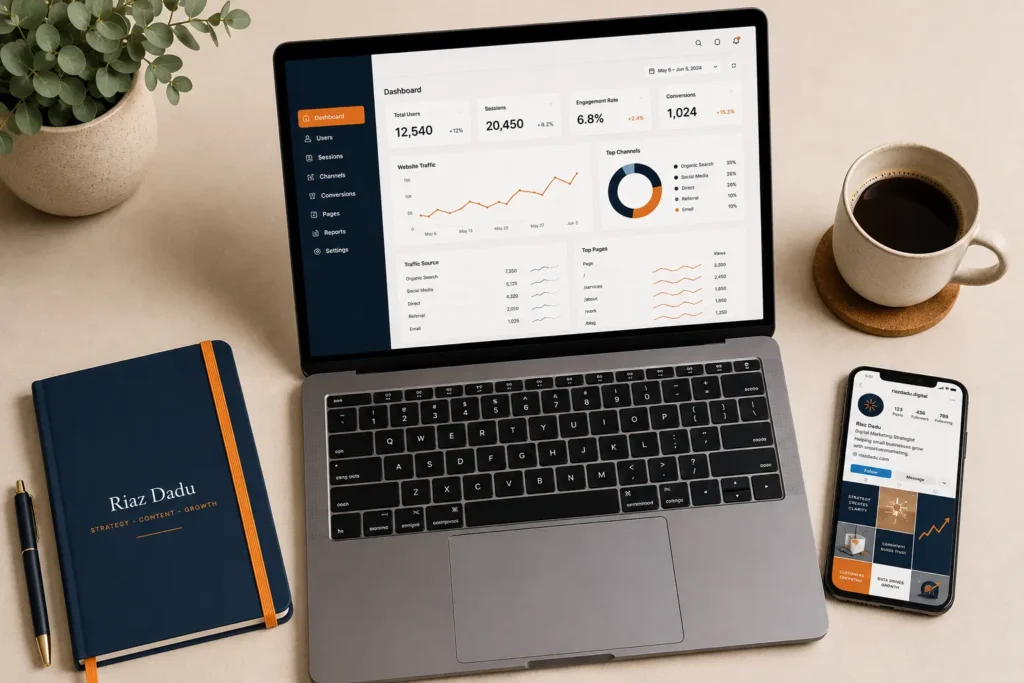
Use Google Analytics to track website traffic, page performance, and how visitors behave once they land on your site. Use Meta Business Suite to monitor social reach and engagement. Review your numbers consistently — weekly for paid campaigns, monthly for organic channels.
Ask the right questions. Which pages bring the most qualified visitors? Which posts are getting saved and shared? Which email subject lines are actually getting opened? The answers tell you exactly where to focus your energy next.
One More Thing: Your Brand Has to Look the Part
Before any of these strategies reach their full potential, your business needs a professional visual identity. Your logo, your colours, your typography, and the overall look of your social media and website must communicate trust and quality at a glance.
Most small business owners underestimate how much visual first impressions affect buying decisions. Our graphics design team builds brand identities that make small businesses look like established industry leaders from the very first interaction.
Put These Digital Marketing Tips for Small Business Growth to Work Today
Digital marketing tips for small business success are most powerful when you act on them consistently — not just read them once. You now have a clear, prioritised roadmap covering every major channel: website, SEO, social media, content, email, paid ads, and AI automation.
The next step is implementation. And that is exactly where having the right team behind you makes all the difference.
we help businesses across Europe, the USA, and Canada grow their online presence through Web Design, Graphics Design, Digital Marketing, and AI Automation. Whether you are starting from scratch or scaling what you already have, we are ready to grow with you.
Reach out today:
Frequently Asked Questions
What are the best digital marketing tips for small business owners just starting out?
A: Start with a professional website and claim your Google Business Profile. These two steps give you a credible, findable presence immediately. Once those are in place, focus on on-page SEO to start attracting organic traffic without paying for every visitor. Build your email list from day one so you own your audience rather than renting it from social platforms.
How much should a small business spend on digital marketing?
A: A widely used benchmark is five to ten percent of your revenue. If your budget is limited, prioritise free and low-cost strategies first — SEO, content, and organic social media — before investing in paid advertising. As results build and revenue grows, reinvest a portion back into the channels that have already proven they work for your business.
How long does digital marketing take to produce results?
A: It depends on the channel. Paid advertising can deliver leads within days. SEO and content marketing typically take three to six months to produce meaningful organic traffic. Social media can build momentum faster with consistency. The key point is that digital marketing compounds — the earlier you start, the larger and more sustainable the returns over time.
Does a small business need to be on every social media platform?
A: No. It is far better to show up consistently and with quality on one or two platforms than to spread yourself thin across five. Find out where your ideal customers actually spend their time and focus your energy there. One excellent platform presence will always outperform several mediocre ones.
Can AI automation genuinely help a small business with marketing?
A: Absolutely. AI tools can handle scheduling, content drafting, customer query responses, and marketing data analysis. At Noa Vecta, we build AI automation workflows specifically designed around small business marketing operations. The time savings are real and the cost of entry is lower than most business owners expect.
How do I know if my digital marketing is actually working?
A: Define clear success metrics before you start. For organic traffic, track monthly website sessions. For ads, monitor cost per lead and conversion rate. For social media, watch reach, engagement, and profile visits. Review these numbers regularly — weekly for paid campaigns, monthly for organic. When something is not moving after three consistent months, adjust the strategy rather than abandoning the channel entirely.