Introduction
What is AI, and why does it seem to be everywhere right now — in our phones, our workplaces, and our news feeds? Artificial intelligence has moved from science fiction to everyday reality faster than almost any technology in history. From the moment you unlock your phone with your face to the moment a streaming app recommends your next favorite show, AI is quietly working in the background of modern life.
In this guide, we’ll break down what is AI in plain language, how it actually works, the different types you’ll hear about, and where it’s headed next. Whether you’re a curious beginner, a business owner exploring automation, or a student researching the topic, this article will give you a clear, complete, and practical understanding of artificial intelligence.
What Is AI?
So, what is AI at its core? According to IBM’s definition of artificial intelligence, AI refers to computer systems built to perform tasks that normally require human intelligence. This includes things like understanding language, recognizing images, making decisions, solving problems, and learning from experience.
Unlike traditional software, which follows fixed, pre-written instructions, AI systems can adapt their behavior based on data. Instead of a programmer writing every single rule, an AI model is trained on large amounts of information and learns patterns on its own. This is what allows AI to translate languages, diagnose diseases from scans, drive cars, and hold conversations.
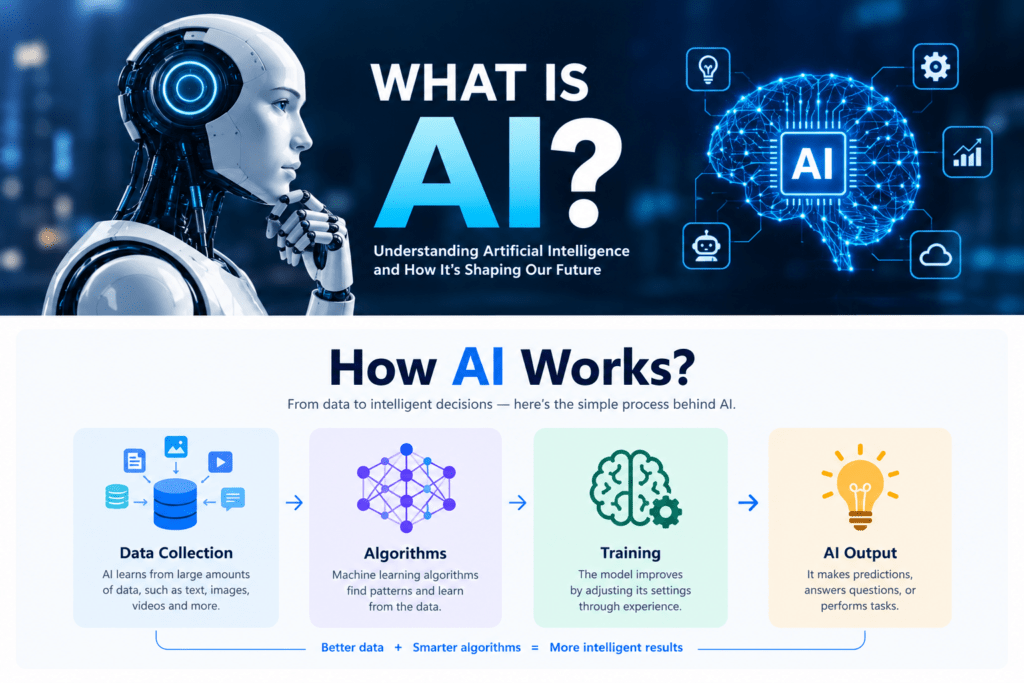
At a basic level, every AI system does three things:
- Receives input — text, images, audio, sensor data, and so on.
- Processes that input using trained models and algorithms.
- Produces an output — a prediction, a decision, a piece of generated content, or an action.
The “intelligence” part comes from how well the system generalizes what it has learned to new, unseen situations, rather than simply memorizing examples.
A Short History of AI
Understanding what is AI today is easier when you see where it came from. As explained in Britannica’s overview of artificial intelligence, the term “artificial intelligence” was coined in 1956 at a conference at Dartmouth College, where researchers first proposed that machines could be made to simulate human reasoning. Early AI programs could play checkers or solve simple logic puzzles, but progress was slow and limited by the computing power of the time.
The field went through several “AI winters” — periods when funding and interest dropped because early promises outpaced actual results. Things changed dramatically in the 2010s with three developments: much larger datasets, far more powerful computer chips (especially GPUs), and improved algorithms called deep neural networks. This combination powered breakthroughs in image recognition, speech recognition, and eventually large language models capable of writing, reasoning, and holding natural conversations.
Today’s AI systems, including generative AI tools, are the direct result of decades of research finally meeting the computing power needed to make them practical.
How Does AI Work?
Show Image
To really understand what is AI, it helps to look under the hood at the core techniques that make it function.
Machine Learning
Machine learning is the foundation of most modern AI, and it’s the best starting point for anyone asking what is AI at a technical level. Instead of being explicitly programmed with rules, a machine learning model is shown large amounts of example data — like thousands of photos labeled “cat” or “not cat” — and it learns the patterns that distinguish one from the other. Once trained, it can apply that learning to brand-new data it has never seen before.
Deep Learning
Deep learning is a specialized branch of machine learning that uses artificial neural networks, loosely inspired by the structure of the human brain. These networks have many layers (“deep” refers to the number of layers), allowing them to learn increasingly complex patterns — from simple edges in an image to complete objects and scenes. Deep learning is the technology behind most breakthroughs in image recognition, voice assistants, and language models — and it’s a big part of the answer whenever someone asks what is AI capable of today.
Natural Language Processing (NLP)
Natural language processing is the branch of AI focused specifically on understanding and generating human language. NLP allows AI systems to read text, understand its meaning, answer questions, summarize documents, and generate human-like responses. It’s the technology that powers chatbots, translation tools, and writing assistants — arguably the clearest everyday example of what is AI when people interact with it directly.
Together, these techniques allow modern AI systems to handle tasks that once seemed uniquely human.
Types of AI: What Is AI’s Full Range of Capability?
When people ask what is AI, they’re often surprised to learn that “AI” isn’t one single thing — it exists on a spectrum of capability.
Narrow AI (Weak AI)
Narrow AI is designed to perform one specific task extremely well, such as recommending products, detecting spam emails, or recognizing faces. Nearly every AI system in use today — including voice assistants and recommendation engines — falls into this category. It can be highly capable within its lane but cannot perform tasks outside what it was designed for.
General AI (Strong AI)
General AI, or Artificial General Intelligence (AGI), refers to a hypothetical system with human-level intelligence across virtually any task — able to reason, learn, and adapt the way a person can. AGI does not yet exist; it remains a long-term research goal rather than a current reality.
Super AI
Superintelligent AI describes a theoretical future system that would surpass human intelligence in every domain, including creativity and problem-solving. This concept is widely discussed in AI research and ethics circles, but it remains speculative and is not something currently in existence.
Understanding these categories helps clarify that today’s AI, however impressive, is still narrow — powerful within specific tasks, not broadly “thinking” like a human.
Real-World Applications: What Is AI Used For?
AI already touches far more of daily life than most people realize. Here’s a look at what is AI actually used for today, across major industries:
- Healthcare — AI helps analyze medical images, detect diseases earlier, and assist in drug discovery.
- Finance — Banks use AI for fraud detection, credit scoring, and algorithmic trading.
- Retail and E-commerce — Product recommendations, demand forecasting, and dynamic pricing rely heavily on AI.
- Transportation — Self-driving technology, route optimization, and traffic prediction all use AI systems.
- Customer Service — Chatbots and virtual assistants handle support inquiries around the clock.
- Content Creation — Writing assistants, image generators, and editing tools use AI to speed up creative work.
- Manufacturing — Predictive maintenance and quality control systems use AI to reduce downtime and defects.
These examples show that AI isn’t a distant future concept — it’s a practical tool already reshaping how industries operate. If you’re a business owner looking to put this into practice, our AI Automation services connect your existing apps and handle repetitive tasks automatically, so your team can focus on higher-value work.
Benefits of AI: What Is AI Actually Good For?
The rapid adoption of AI comes down to the real, measurable advantages it offers:
- Efficiency — AI can process huge volumes of data far faster than humans, automating repetitive tasks.
- Accuracy — In many domains, like image analysis, AI can reduce human error.
- 24/7 Availability — Unlike people, AI systems don’t need breaks, enabling round-the-clock service.
- Personalization — AI tailors experiences, from shopping recommendations to learning platforms, to individual users.
- Cost Savings — Automating routine work can significantly lower operating costs for businesses.
- New Capabilities — AI enables entirely new products and services that weren’t possible before, from real-time translation to advanced diagnostics.
These same benefits apply directly to marketing: AI now plays a growing role in digital marketing, from audience targeting to ad optimization, helping businesses spend smarter and see better returns.
Challenges and Risks: What Is AI Getting Wrong?
No honest answer to “what is AI” would be complete without addressing its real challenges:
- Bias — AI systems learn from data, and if that data reflects human bias, the AI can reproduce or even amplify it.
- Privacy — AI often relies on large datasets, raising legitimate questions about how personal data is collected and used.
- Job Displacement — Automation may reduce demand for certain kinds of routine work, requiring workers to reskill.
- Misinformation — Generative AI can be misused to create convincing false content, such as deepfakes.
- Transparency — Some AI models, especially deep learning systems, function as “black boxes,” making their decisions hard to explain.
- Security — AI systems can be targeted by adversarial attacks or misused for malicious purposes.
Responsible AI development focuses on addressing these risks through better data practices, regulation, and ongoing research into safety and fairness.
The Future of AI: What Is AI Becoming?
Looking ahead, AI is expected to become more capable, more integrated into everyday tools, and more regulated as governments work to balance innovation with safety. Trends to watch include multimodal AI (systems that understand text, images, and audio together), more efficient models that require less computing power, and growing emphasis on AI safety and governance.
As AI capabilities expand, the conversation is shifting from simply “what is AI” to “how should AI be used responsibly.” That shift — toward thoughtful, human-centered deployment — will likely define the next decade of the technology.
Frequently Asked Questions
What is AI in one sentence? AI is software that learns from data to perform tasks — like recognizing images, understanding language, or making predictions — that normally require human intelligence.
Is AI the same as robotics? No. AI is the “intelligence” or software that makes decisions, while robotics involves physical machines. A robot can use AI, but AI itself doesn’t require a physical body.
Can AI think like a human? Not yet. Current AI, including advanced language models, recognizes patterns and generates responses based on training data — it doesn’t have consciousness, understanding, or feelings the way humans do.
Is AI dangerous? AI itself isn’t inherently dangerous, but like any powerful technology, it carries risks if misused or poorly designed. Ongoing research into AI safety aims to minimize these risks.
Do I need to be a programmer to use AI? No. Many AI tools today, from chatbots to design assistants, are built for everyday users with no coding required.
Conclusion
So, what is AI, in simple terms? It’s technology that allows machines to learn from data and perform tasks that once required human intelligence — from recognizing images to writing text to making predictions. It has a rich history, powerful underlying techniques like machine learning and deep learning, and applications that already touch nearly every industry.
As AI continues to evolve, understanding the basics — what it is, how it works, and where its risks lie — puts you in a better position to use it wisely, whether in your personal life or your business. AI isn’t magic, and it isn’t science fiction anymore either. It’s a practical, powerful tool, and understanding it is the first step to using it well.
If you’re ready to put AI to work for your business, get in touch and let’s talk about where automation and AI-driven marketing can make the biggest difference for you.