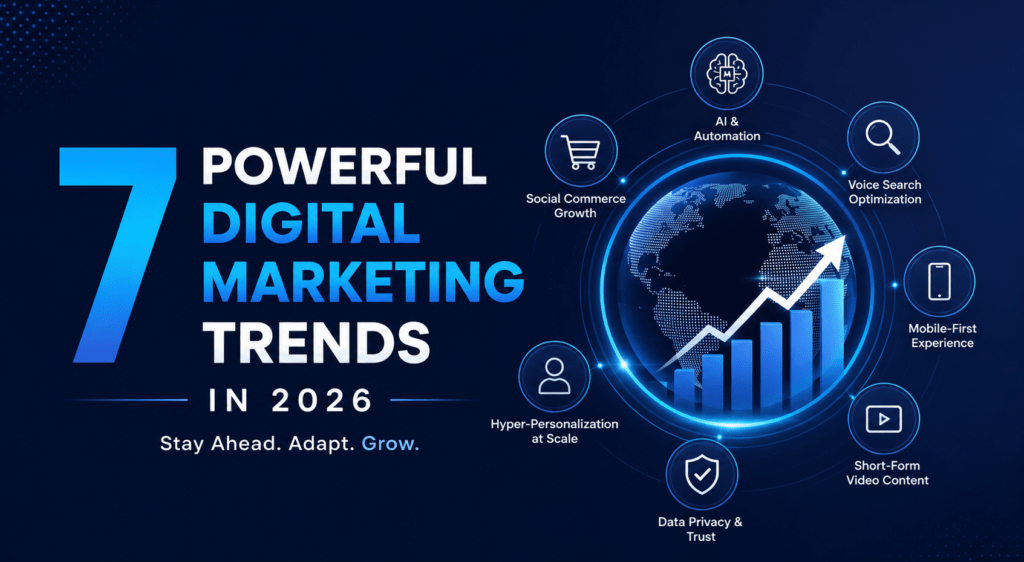
7 Powerful Digital Marketing Trends 2026
7 Powerful Digital Marketing Trends 2026
The digital marketing trends 2026 landscape has shifted more dramatically in the past 12 months than in the previous five years combined — and the brands that understand this shift are already outperforming their competitors by a wide margin. Artificial intelligence, zero-click search, and hyper-personalization are no longer optional upgrades; they are the baseline every serious business must meet.
This comprehensive guide from Riazdadu Agency explores the 7 most impactful digital marketing trends in 2026. Each section goes beyond surface-level advice to give you the strategic framework, real-world statistics, actionable steps, and common pitfalls you need to navigate the year ahead with confidence.
Whether you are a startup founder, a marketing manager at a growing company, or an enterprise CMO, this guide is written for you.
| Riazdadu Agency We have helped over 200 businesses across Bangladesh and beyond build digital marketing strategies that deliver measurable results. Everything in this guide is drawn from our frontline experience. Visit riazdadu.com to learn more about our services. |
Why 2026 Is a Watershed Year for Digital Marketing
Every year brings change to the digital marketing landscape, but 2026 is different in kind, not just degree. Three major forces have converged to fundamentally reshape how brands connect with audiences:
1. The AI Inflection Point
Large language models and generative AI tools have crossed the threshold from experimental novelty to production-grade utility. Brands are now using AI at every stage of the marketing funnel — from generating content and designing creatives to predicting customer lifetime value and automating customer service. The competitive advantage belongs to those who use AI strategically, not just experimentally.
2. The Death of Third-Party Cookies
With Google completing the deprecation of third-party cookies in Chrome and all major browsers following suit, the data infrastructure that powered programmatic advertising for two decades has collapsed. Marketers who spent 2023–2025 building first-party data assets are now pulling ahead. Those who did not are facing rising CPMs, falling ROAS, and audiences they can no longer identify.
3. The Trust Deficit
Consumer trust in digital advertising has hit a historic low. Ad blockers are used by 42% of internet users globally. Audiences are tuning out interruptive formats and gravitating toward brands that educate, entertain, and build genuine community. Authenticity is not a brand value anymore — it is a competitive requirement.
Understanding these three macro forces is essential context for the 7 digital marketing trends in 2026 we outline below.
Trend 1: AI-Driven Content Creation and Strategy
Artificial intelligence has fundamentally changed what it means to create content at scale. In 2026, the question is no longer whether to use AI in your content workflow — it is how to use it without losing the human quality that builds audience trust.
The Current State of AI in Content Marketing
A 2025 Content Marketing Institute report found that 78% of content marketing teams now use AI tools in some part of their workflow. The most common applications are:
- First-draft generation for blog posts, social captions, and email subject lines
- SEO keyword clustering and content gap analysis
- Automated meta description and title tag generation
- Content repurposing: turning one long-form piece into 10+ derivative formats
- Sentiment analysis of customer reviews and social mentions
However, the brands seeing the highest ROI from AI content are not those using it to replace human writers — they are the ones using it as a force multiplier. At Riazdadu Agency, our content teams use AI to produce research briefs, competitive analysis, and structural outlines, then human writers craft the final piece. The result: content that ranks because it is optimized, and converts because it is genuinely useful.
AI Content and Google’s Helpful Content System
Google’s Helpful Content System, continuously updated since 2022, now de-prioritizes content that demonstrates low experience, expertise, authority, and trustworthiness (E-E-A-T). This means pure AI-generated content that lacks original perspective, firsthand experience, or expert insight consistently underperforms in search.
The winning formula in 2026 is: AI efficiency + human expertise + strategic SEO = content that ranks and resonates.
| Common Mistake to Avoid Publishing raw AI-generated content without human review and editorial oversight. Google’s systems are increasingly sophisticated at detecting thin, formulaic content, and audiences can tell the difference. Always add original data, expert quotes, or case studies before publishing. |
How to Implement AI Content Strategy in 2026
Step-by-step framework from the Riazdadu Agency content team:
- Audit your current content workflow and identify the highest-friction tasks (ideation, briefs, outlines, meta data).
- Select AI tools suited to your budget: ChatGPT, Claude, Jasper, or Rank Math’s Content AI for integrated SEO.
- Create a brand voice guide and prompt library so AI outputs stay on-brand.
- Establish a human review checklist: fact accuracy, E-E-A-T signals, original perspective, keyword placement.
- Measure performance at 30, 60, and 90 days. Optimize prompts and workflows based on ranking and engagement data.
| Riazdadu Agency Tip Our content audits consistently show that clients can increase their content output by 3x using a well-structured AI-assisted workflow, without compromising quality. Ask us about our Content Acceleration Package at riazdadu.com. |
Trend 2: Zero-Click Search and Answer Engine Optimization (AEO)
Search behavior is undergoing its most digital marketing trends 2026 dramatic shift since the introduction of mobile search. In 2026, more than 65% of Google searches end without a user clicking through to any website. Featured snippets, AI-generated overviews, knowledge panels, and local packs are capturing the intent directly on the results page.
What Is Answer Engine Optimization?
Answer Engine Optimization (AEO) is the practice of structuring your content so that search engines — and increasingly, AI assistants like Google Gemini, ChatGPT, and Perplexity — select it as the authoritative answer to user queries. It is SEO evolved for an era where the search engine itself is the final destination.
AEO differs from traditional SEO in a critical way: the goal is not just to rank on page one, but to own the answer. This requires a different content architecture, a different keyword strategy, and a different relationship between your content and structured data.
The AEO Framework: 4 Pillars
Pillar 1: Question-Based Content Architecture
Structure every key page around the questions your audience is actually typing and speaking. Use tools like AnswerThePublic, AlsoAsked, and Google’s People Also Ask section to build a comprehensive question map for each topic cluster.
- Open each section with the exact question, then answer it in the first 2–3 sentences.
- Use headers formatted as questions (H2, H3) to signal structure to search engines.
- Include a dedicated FAQ section on every pillar page.
Pillar 2: Schema Markup
Schema markup (structured data) tells search engines exactly what type of content is on your page. In 2026, the most impactful schema types for AEO are:
- FAQPage – surfaces directly as expandable Q&A in search results
- HowTo – appears as a step-by-step process in rich results
- Article – establishes authorship and publication date for E-E-A-T
- LocalBusiness – critical for service businesses competing for local packs
- Product – essential for e-commerce with price, availability, and review data
Pillar 3: Concise, Scan-Ready Answers
Featured snippets typically pull answers of 40–60 words for definitions, 3–8 items for lists, and 45–60 words for process steps. Write with this density in mind. Every section of your content should be able to stand alone as a self-contained answer.
Pillar 4: Voice Search Optimization
Voice searches are conversational, local, and action-oriented. Optimize for natural language queries: ‘What is the best digital marketing agency near me?’ rather than ‘best digital marketing agency.’ Use a conversational tone throughout your content, and make sure your Google Business Profile is fully optimized.
| Riazdadu Agency Tip We implement full AEO audits as part of our SEO service packages. This includes schema markup installation via Rank Math Pro, FAQ section copywriting, and voice search keyword mapping. Contact us at riazdadu.com to get started. |
Trend 3: How Digital Marketing Trends 2026 Are Reshaping Social Commerce
Digital marketing trends 2026Social commerce — the integration of shopping functionality directly into social media platforms — has matured from a feature into a full commerce channel. In 2026, TikTok Shop, Instagram Checkout, Pinterest Shopping, and YouTube Shopping have created a new category of consumer behavior: the social buyer.
The Numbers Behind Social Commerce in 2026
The scale of social commerce growth is hard to overstate. Consider these industry figures:
$1.2 trillion — Projected global social commerce revenue by end of 2026
73% — of Gen Z consumers have made a purchase directly through a social platform
3x — higher conversion rate for live shopping events vs. static product ads
62% — of consumers say they discover new products primarily through social media
The 3 Pillars of a Social Commerce Strategy
Pillar 1: Shoppable Content
Every piece of content your brand publishes should be shoppable in 2026. Digital marketing trends 2026 This means tagging products in Instagram and TikTok posts, adding product links to Pinterest pins, and embedding shopping cards in YouTube videos. The friction between content and conversion must be eliminated.
- Create a product content calendar separate from your brand content calendar.
- Invest in high-quality product photography and short demo videos (15–30 seconds).
- Use UGC (user-generated content) to supplement branded content — UGC drives 4x higher click-through rates on shoppable posts.
Pillar 2: Live Shopping Events
Live commerce is the fastest-growing format in social commerce. Brands that host regular live shopping events — product launches, Q&A sessions, tutorials — report average order values 30% higher than their standard e-commerce baseline. The real-time social proof and scarcity cues create powerful purchase momentum.
- Schedule live events at consistent times to build an audience habit.
- Feature a charismatic host: either a brand ambassador, founder, or specialist.
- Offer live-exclusive discounts or bundles to reward real-time participation.
- Repurpose live content into highlight clips for Stories, Reels, and Shorts.
Pillar 3: Influencer Partnerships
Influencer marketing has matured significantly. In 2026, the most effective partnerships are not with mega-influencers (1M+ followers) but with micro-influencers (10k–100k followers) and nano-influencers (1k–10k followers) who operate in tight-knit communities with high trust and engagement.
- Evaluate influencers on engagement rate, audience demographics, and content quality — not follower count alone.
- Build long-term ambassador relationships rather than one-off paid posts.
- Use affiliate tracking links and promo codes to measure ROI on every partnership.
| Riazdadu Agency Tip Our Social Commerce team builds end-to-end shoppable content strategies: from platform setup and product feed optimization to influencer sourcing and live event production. Let us build your social commerce engine. Visit riazdadu.com. |
Trend 4: Hyper-Personalization Through First-Party Data
The post-cookie era is now fully upon us. Third-party data — the behavioral data collected by ad networks and data brokers across the web — is no longer a viable foundation for targeting. In 2026, the brands winning the personalization game are those who spent the last two years building their own data infrastructure.
What Is First-Party Data and Why Does It Matter?
First-party data is information you collect directly from your audience through your own channels: website behavior, email engagement, purchase history, survey responses, loyalty program activity, and customer service interactions. Unlike third-party data, it is accurate, consent-based, privacy-compliant, and unique to your brand.
In a cookieless world, first-party data is the only data you can rely on. And the brands with the richest first-party data assets will have a structural competitive advantage that compounds over time.
Building a First-Party Data Infrastructure
Step 1: First-Party Data Collection Points
Map every touchpoint where your audience interacts with your brand and identify opportunities to capture data:
- Website: newsletter signup forms, gated content downloads, account registration, quiz funnels, preference centers
- Email: click behavior, open rates, product browsing patterns tracked via pixel
- E-commerce: purchase history, cart abandonment, wishlist items, product reviews
- Loyalty programs: points activity, referral behavior, redemption preferences
- Customer service: support ticket topics, satisfaction scores, churn signals
Step 2: CDP (Customer Data Platform) Integration
A Customer Data Platform (CDP) unifies all of your first-party data sources into a single customer profile. Leading CDPs in 2026 include Segment, Bloomreach, Klaviyo, and Adobe Real-Time CDP. With a CDP, you can create behavioral segments that power hyper-personalized campaigns across email, paid ads, website content, and push notifications.
Step 3: Personalization Execution
With a unified customer view, personalization becomes systematic:
- Email: Dynamic content blocks that change based on customer segment, purchase history, or last interaction
- Website: Homepage hero images, product recommendations, and pop-up offers tailored to each visitor segment
- Paid ads: Lookalike audiences built from your highest-LTV customers instead of third-party interest segments
- SMS and Push: Behavioral triggers (abandoned cart, price drop, restock) sent in real time
| Common Mistake Collecting data without a clear activation strategy. Many brands have rich CRM data sitting unused. The goal is not data collection — it is data activation: turning behavioral signals into relevant, timely communication that drives conversion. |
| Riazdadu Agency Tip We help clients design first-party data strategies from the ground up: from lead magnet development and email list architecture to CDP setup and personalization campaign execution. A strong data strategy is the foundation of everything we build at Riazdadu Agency. |
Trend 5: Video-First Content Across Every Channel
Video has been ‘the next big thing’ in digital marketing for the better part of a decade. In 2026, it is no longer next — it is now, and it is everywhere. The brands that treat video as a core content format rather than a supplementary one are consistently outperforming their peers on engagement, reach, and conversion.
The Short-Form vs Long-Form Divide
The 2026 video landscape is bifurcated. Short-form video (under 60 seconds) dominates awareness and discovery: TikTok, Instagram Reels, YouTube Shorts, and LinkedIn Video collectively account for over 3 billion daily video views. But long-form content (10+ minutes on YouTube, webinars, video courses) is making a significant comeback for consideration and conversion, particularly in B2B.
The most sophisticated content teams are building full-funnel video strategies that use both:
- Short-form for top-of-funnel: brand awareness, product teases, trend participation, and community building
- Mid-form (2–5 minutes) for middle-of-funnel: product explainers, testimonials, case studies, and how-tos
- Long-form for bottom-of-funnel: deep-dive tutorials, webinars, live Q&As, and product demos
Video SEO: Getting Your Content Discovered
Creating video is only half the battle. Getting it discovered requires a disciplined video SEO approach:
- YouTube titles: Include your primary keyword in the first 60 characters. Use power words and numbers.
- Descriptions: Write 250+ word descriptions with keyword-rich context, timestamps, and links to related content.
- Chapters: Add timestamped chapters to every long-form video. YouTube surfaces chapters in search results.
- Transcripts: Upload accurate transcripts to help YouTube index the full spoken content of your video.
- Thumbnails: Use consistent, high-contrast designs with facial close-ups when possible — they drive 30% higher CTR.
Cross-Platform Video Repurposing
One of the highest-ROI activities in video marketing is systematic repurposing. A single 20-minute YouTube video can generate:
- 3–5 short-form clips for TikTok, Reels, and Shorts
- 1 blog post (from the transcript, lightly edited)
- 5–8 quote graphics for LinkedIn and Instagram
- 1 email newsletter summarizing the key points
- 1 podcast episode (audio extracted with a branded intro/outro)
| Riazdadu Agency Success Story One of our e-commerce clients saw a 218% increase in organic reach and a 67% increase in product page traffic within 90 days of launching a structured video content and repurposing system we built for them. The entire strategy was built around a single weekly video shoot. |
Trend 6: Conversational Marketing and AI-Powered Customer Engagement
Customers in 2026 expect on-demand, personalized communication at every touchpoint. The era of ‘fill out this form and we will get back to you in 2–3 business days’ is over. Brands that respond instantly, contextually, and helpfully are capturing the leads and sales that slow responders are losing.
The Conversational Marketing Stack in 2026
Conversational marketing encompasses every channel where a brand and customer can have a real-time, two-way dialogue. In 2026, the primary channels are:
| Channel | Primary Use Case | Key Tool |
| Website Chat | Lead qualification, FAQ, booking | Intercom, Drift, Tidio |
| WhatsApp Business | Customer support, order updates, promotions | WhatsApp API, Wati |
| Facebook Messenger | Retargeting, customer service, offers | ManyChat, Chatfuel |
| Instagram DMs | Influencer inquiries, product Q&A, UGC | ManyChat Instagram |
| SMS Marketing | Flash sales, appointment reminders, cart recovery | Klaviyo SMS, Postscript |
| AI Voice Assistants | Voice search, FAQ, local business info | Google Assistant, Alexa |
Building a Chatbot That Converts
Most chatbots fail because they are designed as cost-saving tools rather than conversion tools. The most effective chatbots in 2026 are built around the customer journey, not the company’s internal FAQ. Here is the framework Riazdadu Agency uses for every chatbot deployment:
- Map the top 10 questions customers ask before making a purchase decision. These become the chatbot’s primary conversation flows.
- Design for qualification, not just information. Each conversation should end with either a booked call, a captured email, or a product recommendation.
- Build escalation paths: when the bot cannot help, route to a human agent immediately, not after a frustrating loop of unhelpful responses.
- Use personalization tokens to address returning visitors by name and reference their previous interactions.
- A/B test conversation scripts every 60 days and optimize toward conversion, not just engagement.
| Riazdadu Agency Tip We build and deploy custom chatbot systems on WhatsApp, website, and Messenger for our clients. Our chatbot setups typically increase lead capture rates by 35–55% compared to standard contact forms. See our Conversational Marketing service at riazdadu.com. |
Trend 7: Sustainable and Purpose-Driven Brand Marketing
The final — and perhaps most underestimated — trend shaping digital marketing in 2026 is the shift toward purpose-driven brand building. Consumers are making purchasing decisions based not just on product quality and price, but on the values, ethics, and environmental commitments of the brands they support.
The Data on Purpose-Driven Marketing
72% — of Gen Z consumers say they will pay more for products from brands committed to positive social and environmental impact (Deloitte, 2025)
65% — of consumers globally have boycotted a brand in the last 12 months due to values misalignment
3x — higher brand loyalty scores for purpose-driven brands vs. product-centric brands
What Purpose-Driven Marketing Looks Like in Practice
Purpose-driven marketing is frequently misunderstood as cause-related PR stunts. In 2026, the brands doing it well are embedding purpose into their operations and communicating it consistently, not just during awareness months or PR opportunities.
Transparency and Impact Reporting
Publish an annual impact report that details your environmental footprint, supply chain practices, community contributions, and employee wellbeing initiatives. Even small businesses benefit from this level of transparency. It builds trust, attracts values-aligned customers, and differentiates you from competitors who have nothing to say beyond product features.
Community-First Content
The most powerful purpose-driven content tells the story of the people your brand serves and the communities it operates within. For a Bangladesh-based agency like Riazdadu Agency, this means celebrating local entrepreneurship, sharing client success stories, and contributing educational content that helps the broader business community grow.
Cause Marketing Partnerships
Partner with nonprofits, educational institutions, or social enterprises whose missions align with your brand values. Donate a percentage of revenue, sponsor local events, or offer pro-bono services to organizations doing important work. These partnerships generate genuine goodwill, press coverage, and social proof — and they attract customers who want to spend money with businesses that stand for something.
| Greenwashing Warning Consumers in 2026 are highly attuned to performative purpose claims. Vague language like ‘we care about the planet’ without specific, verifiable actions will actively harm your brand reputation. If you make a sustainability claim, back it with data, certifications, or third-party verification. |
Top Digital Marketing Tools for 2026: The Riazdadu Agency Recommended Stack
Based on our agency’s day-to-day work across SEO, content, paid media, and social, here are the tools we recommend for each category of digital marketing in 2026:
| Category | Recommended Tools |
| SEO & AEO | Rank Math Pro, Ahrefs, Semrush, Surfer SEO, Google Search Console |
| AI Content | Claude (Anthropic), ChatGPT Plus, Jasper, Rank Math Content AI |
| Email Marketing | Klaviyo, Mailchimp, ActiveCampaign, Brevo |
| Social Media Mgmt | Buffer, Hootsuite, Later, Metricool |
| Video Production | CapCut, DaVinci Resolve, Canva Video, Descript |
| Chatbots & Conv. Mktg | ManyChat, Tidio, Intercom, Wati (WhatsApp) |
| Analytics | Google Analytics 4, Hotjar, Clarity, Looker Studio |
| CRM / CDP | HubSpot, Klaviyo, Salesforce, Segment |
| Paid Advertising | Google Ads, Meta Ads Manager, TikTok Ads, LinkedIn Campaign Mgr |
| Design & Creative | Canva Pro, Adobe Express, Figma |
5 Critical Digital Marketing Mistakes to Avoid in 2026
For every trend to embrace, there is a corresponding trap to avoid. Here are the five most costly mistakes we see brands making as they navigate the digital marketing landscape in 2026:
Mistake 1: Treating AI as a Replacement, Not a Tool
The brands that layoff their content teams and replace them entirely with AI are seeing short-term cost savings and long-term brand erosion. AI content without human oversight lacks the experience, nuance, and originality that Google rewards and audiences value. Use AI to work smarter, not to eliminate the human expertise that makes your content trustworthy.
Mistake 2: Ignoring Your Google Business Profile
For local and regional businesses, Google Business Profile (GBP) is one of the highest-ROI digital marketing assets available. Yet most businesses treat it as a set-and-forget directory listing. In 2026, regular GBP posts, updated photos, review responses, and Q&A management can drive significant local search visibility — often outperforming a fully built SEO campaign for local intent queries.
Mistake 3: Measuring Vanity Metrics
Follower counts, impressions, and likes are not business metrics. In 2026, every digital marketing activity should be tied to revenue impact: leads generated, cost per acquisition, customer lifetime value, and return on ad spend. If you cannot draw a line from your social media posts to pipeline or revenue, you need to rethink your measurement framework.
Mistake 4: Underinvesting in Email Marketing
Despite the constant proclamations of its death, email marketing continues to deliver the highest ROI of any digital channel: an average of $36 for every $1 spent (DMA, 2025). Yet many brands underinvest in their email programs, sending generic blasts to unsegmented lists. In 2026, a properly segmented, automated, and personalized email program is a revenue machine that compounds in value over time.
Mistake 5: Inconsistent Brand Voice Across Channels
In a multi-channel world, your audience encounters your brand across search, social, email, chat, and paid ads — often within the same hour. Inconsistent tone, messaging, and visual identity across these touchpoints erodes brand recognition and trust. Invest in a comprehensive brand guidelines document and train every person and tool that produces content for your brand.
Your 90-Day Digital Marketing Action Plan for 2026
Reading about trends is useful. Acting on them is what creates results. Here is a prioritized 90-day roadmap to implement the digital marketing trends in 2026, designed for teams with limited resources and unlimited ambition:
| Timeline | Priority Action | Expected Outcome |
| Days 1–15 | Audit existing content for AEO gaps. Install Rank Math Pro. Add FAQ schema to top 10 pages. | Improved snippet eligibility within 30–60 days |
| Days 1–15 | Set up Google Analytics 4 properly with conversion events. Define your north-star metric. | Baseline data for all future decisions |
| Days 16–30 | Launch first-party data capture: create a lead magnet, set up email automation sequence. | Begin building owned audience asset |
| Days 16–30 | Optimize Google Business Profile: add photos, enable messaging, respond to all reviews. | Boost in local search visibility within 2–3 weeks |
| Days 31–60 | Develop a content repurposing system: turn 1 core piece into 5+ derivative formats per week. | 3x content output with same resource investment |
| Days 31–60 | Deploy a website chatbot with a lead qualification flow. | Increase in lead capture rate from website traffic |
| Days 61–90 | Launch your first social commerce initiative: shoppable posts or a live shopping event. | New revenue channel from existing social audience |
| Days 61–90 | Review all marketing against brand voice guidelines. Standardize tone across all channels. | Stronger brand recognition and audience trust |
Frequently Asked Questions About Digital Marketing in 2026
Q: What is the most important digital marketing trend in 2026?
A: There is no single most important trend — the brands that win in 2026 are those who integrate multiple trends into a coherent strategy. That said, if you are choosing where to start, AI-assisted content production and AEO (Answer Engine Optimization) offer the fastest path to organic visibility gains with a relatively modest resource investment.
Q: How much should I budget for digital marketing in 2026?
A: Industry benchmarks suggest allocating 7–12% of revenue to marketing for established businesses, and 12–20% for brands in growth mode. Within that budget, the highest-ROI allocations in 2026 are: SEO and content (40%), email marketing automation (20%), paid social and search (25%), and tools/technology (15%). Contact Riazdadu Agency for a custom budget recommendation based on your business stage and goals.
Q: Is SEO still worth investing in for 2026?
A: Absolutely. Despite the rise of zero-click search and AI overviews, organic search still drives more website traffic than any other channel for most businesses. The strategy has evolved — AEO, E-E-A-T, and topical authority are now more important than raw keyword density — but the underlying value of ranking in search has not diminished. If anything, well-executed SEO is more defensible than ever because it is harder to fake.
Q: How do I know which social media platform to focus on?
A: Follow your audience. Research which platforms your target customers use most actively, then build depth on one or two platforms before expanding. For most B2C brands in 2026, TikTok and Instagram offer the highest organic reach potential. For B2B, LinkedIn remains the dominant channel. Riazdadu Agency offers free social media audits to help you identify where your audience is most reachable.
Q: What is the difference between SEO and AEO?
A: Traditional SEO focuses on ranking your page among the blue links on a search results page, with the goal of driving clicks to your website. Answer Engine Optimization (AEO) goes further: it structures your content to be selected as the direct answer displayed in featured snippets, AI overviews, voice search responses, and knowledge panels — often without the user clicking through at all. In 2026, effective digital marketing requires both: AEO to own the answer and SEO to capture the click.
Q: How can Riazdadu Agency help my business?
A: Riazdadu Agency is a full-service digital marketing agency offering SEO, content marketing, social media management, paid advertising, email marketing automation, and chatbot development. We serve businesses across Bangladesh and internationally. Visit riazdadu.com to explore our service packages and book a free strategy consultation.
Conclusion: The Future Belongs to Brands That Act Now
The 7 powerful digital marketing trends in 2026 outlined in this guide are not isolated developments — they are interconnected forces reshaping the entire ecosystem of how brands reach, engage, and retain customers online. AI drives personalization. Personalization powers social commerce. AEO captures voice search intent. Video builds community. Conversational marketing converts. Purpose builds loyalty.
The brands that will dominate their categories by the end of 2026 are not the ones with the biggest budgets — they are the ones with the most strategic clarity, the most consistent execution, and the deepest understanding of their audience’s needs and behaviors.
At Riazdadu Agency, we live at the intersection of strategy and execution. We do not just advise — we build, launch, optimize, and scale the digital marketing systems that drive real revenue for our clients. If you are serious about making 2026 your best year in business, we would love to be your growth partner.
| 🚀 Ready to turn these trends into results? Visit riazdadu.com to explore our digital marketing services, see our client results, and book a free strategy session with the Riazdadu Agency team. Your competitive advantage in 2026 starts with one conversation. |
About Riazdadu Agency
Riazdadu Agency is a results-driven digital marketing agency based in Bangladesh, serving clients locally and internationally. Our team of strategists, content creators, SEO specialists, and paid media experts works together to deliver integrated digital marketing solutions that drive measurable business growth. From SEO and content marketing to social media, paid advertising, and marketing automation — we build the systems that help brands win online.
Tags: digital marketing trends 2026, AI content marketing, answer engine optimization, social commerce 2026, first-party data, video marketing strategy, conversational marketing, purpose-driven marketing, Riazdadu Agency, SEO 2026, Bangladesh digital marketing