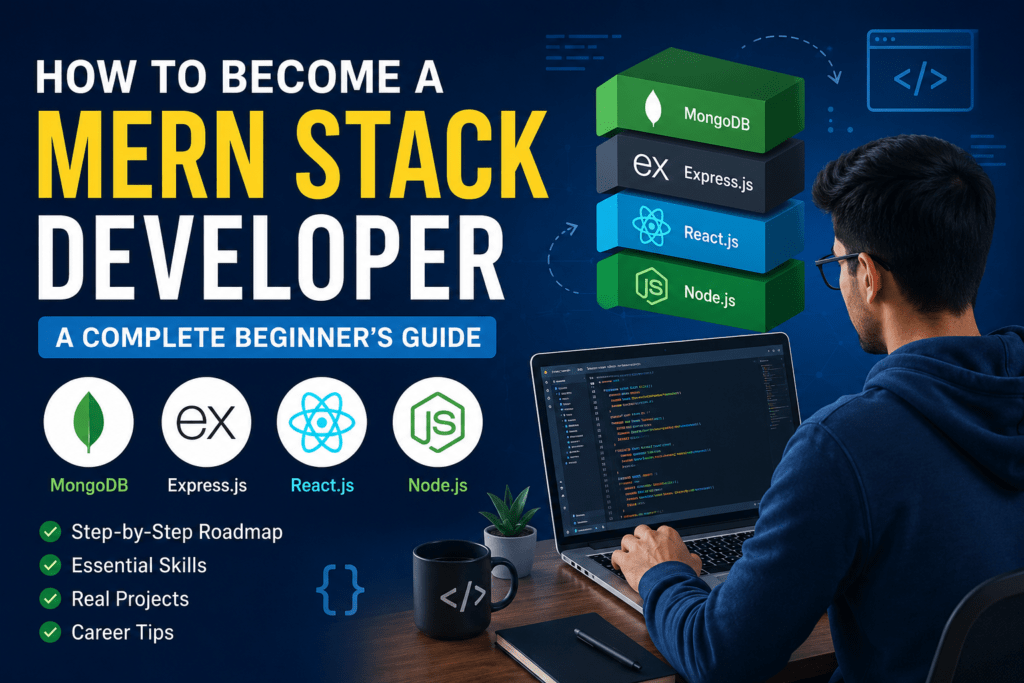
How to become a MERN Stack Developer? If you are interested in web development and want to build modern, fast, and interactive websites, becoming a MERN Stack Developer can be a great career choice. MERN developers work with some of the most popular technologies used to create modern web applications.
The good news is that you do not need to be an expert programmer to start. With the right learning path, regular practice, and real-world projects, you can gradually develop the skills needed to become a professional MERN Stack Developer.
In this guide, you will learn what MERN Stack development is, which technologies you need to learn, how long it can take, what projects you should build, and how you can start your career as a MERN developer.
What Is a MERN Stack Developer?
A MERN Stack Developer is a web developer who uses four major technologies to build full-stack web applications:
- MongoDB – Database
- Express.js – Backend framework
- React.js – Frontend library
- Node.js – JavaScript runtime
The word MERN comes from the first letters of these technologies: MongoDB, Express, React, and Node.js.
One of the biggest advantages of the MERN stack is that developers can use JavaScript for both frontend and backend development. This makes the learning process easier compared with learning completely different programming languages for different parts of an application.
Why Should You Become a MERN Stack Developer?
There are several reasons why MERN Stack development has become popular among beginners and professional developers.
First, JavaScript is widely used in web development. Once you understand JavaScript properly, you can use it to build both the frontend and backend of an application.
React also has a large developer community and is widely used for creating interactive user interfaces.
Another advantage is the availability of learning resources. Beginners can find documentation, tutorials, courses, communities, and open-source projects to help them improve their skills.
MERN development can open different career opportunities, including:
- Frontend Developer
- Backend Developer
- Full Stack Developer
- MERN Stack Developer
- JavaScript Developer
- React Developer
- Node.js Developer
- Freelance Web Developer
MERN Stack Technologies You Need to Learn
To become a successful MERN Stack Developer, you need to understand each part of the stack. You do not have to master everything at once. Learn each technology step by step.
Learn HTML
HTML is the foundation of every website. It is used to create the structure of web pages.
Before learning React, you should understand HTML properly.
Important HTML topics include:
- Headings and paragraphs
- Links
- Images
- Forms
- Tables
- Lists
- Semantic HTML
- HTML attributes
- Input elements
You do not need to spend months learning HTML. Focus on the fundamentals and practice by creating simple web pages.
Learn CSS
After HTML, the next step is CSS.
CSS controls the appearance and layout of a website. It helps you create websites that look professional and work properly on different screen sizes.
You should learn:
- Colors
- Fonts
- Margins and padding
- Box model
- Flexbox
- CSS Grid
- Positioning
- Responsive design
- Media queries
- Basic animations
Responsive design is especially important because websites need to work well on smartphones, tablets, and computers.
Master JavaScript
JavaScript is one of the most important skills for a MERN Stack Developer.
Do not rush into React before understanding JavaScript. A strong JavaScript foundation will make React, Node.js, and Express much easier to learn.
Important JavaScript concepts include:
- Variables
- Data types
- Functions
- Arrays
- Objects
- Loops
- Conditions
- DOM manipulation
- Events
- ES6 features
- Destructuring
- Spread and rest operators
- Array methods
- Promises
- Async/await
- Fetch API
- Modules
- Error handling
Try to solve programming problems regularly. Even small exercises can improve your logical thinking.
Learn Git and GitHub
Git is a version control system that allows developers to track changes in their code.
GitHub is a popular platform where developers store and share their code.
As a professional developer, you should know how to:
- Create a Git repository
- Commit changes
- Create branches
- Merge branches
- Push code to GitHub
- Pull code from repositories
- Work with other developers
- Write a useful README file
A good GitHub profile can also help potential employers and clients see your development skills.
Learn React.js
React is the frontend part of the MERN stack.
React allows developers to create reusable UI components and build interactive web applications.
When learning React, start with the basics instead of trying to learn advanced concepts immediately.
Important React topics include:
- Components
- JSX
- Props
- State
- Events
- Conditional rendering
- Lists
- Forms
- Hooks
- useState
- useEffect
- React Router
- API integration
- Component reusability
After learning the fundamentals, build several small applications such as a to-do application, weather application, product listing page, or expense tracker.
Learn Node.js
Node.js allows you to run JavaScript outside the browser.
It is commonly used to build backend applications and APIs.
You should understand:
- Node.js fundamentals
- npm
- Modules
- File system basics
- Environment variables
- HTTP
- REST APIs
- Asynchronous programming
- Error handling
Node.js becomes much more useful when combined with Express.js.
Learn Express.js
Express.js is a lightweight backend framework for Node.js.
It makes it easier to create APIs and handle server-side requests.
Some important Express concepts include:
- Routes
- Middleware
- Request and response
- REST APIs
- Error handling
- Authentication
- Authorization
- API structure
- HTTP status codes
Once you understand Express, you can start connecting your frontend applications with a backend server.
Learn MongoDB
MongoDB is the database technology used in the MERN stack.
Unlike traditional relational databases, MongoDB stores information in a document-based format.
You should learn:
- Databases
- Collections
- Documents
- CRUD operations
- Queries
- Data relationships
- Indexes
- MongoDB Atlas
- Mongoose
Mongoose is commonly used with Node.js and MongoDB because it makes working with MongoDB easier in many Node.js applications.
Learn REST API Development
APIs allow different parts of an application to communicate with each other.
For example, when a user logs into an application, the frontend can send login information to the backend through an API. The backend processes the request and communicates with the database.
You should understand common HTTP methods such as:
- GET
- POST
- PUT
- PATCH
- DELETE
You should also understand HTTP status codes, JSON, authentication, validation, and error handling.
Learn Authentication and Security
A professional MERN application needs proper security.
You should learn the fundamentals of:
- User registration
- Login systems
- Password hashing
- Authentication
- Authorization
- JWT
- Cookies
- Environment variables
- Input validation
- CORS
- Basic API security
You do not need to become a cybersecurity expert, but you should understand how to protect user data and build applications responsibly.
Build Real MERN Stack Projects
Learning programming only from tutorials is not enough.
One of the best ways to become a MERN Stack Developer is to build real projects.
Start with small projects and gradually increase their complexity.
Beginner MERN Projects
You can start with:
- To-do application
- Personal portfolio website
- Blog application
- Weather application
- Expense tracker
- Notes application
Intermediate MERN Projects
After gaining confidence, build:
- E-commerce website
- Job portal
- Restaurant booking application
- Learning management system
- Social media application
- Inventory management system
Advanced MERN Projects
For advanced practice, consider building:
- Multi-vendor e-commerce platform
- Real-time chat application
- Project management system
- SaaS dashboard
- Online marketplace
- Business management platform
The goal is not simply to have many projects. It is better to have a few high-quality projects that demonstrate your actual skills.
Create a Professional Developer Portfolio
Once you have completed several projects, create a professional portfolio website.
Your portfolio should clearly show:
- Your introduction
- Your skills
- Your projects
- Your GitHub profile
- Your contact information
- Your development experience
For each project, explain what you built, which technologies you used, and what problem the project solves.
A simple but professional portfolio is usually better than a website filled with unnecessary animations.
Learn How to Deploy MERN Applications
Building an application locally is only part of the process. A professional MERN developer should also understand deployment.
You should learn the basics of:
- Hosting
- Domains
- Environment variables
- Production builds
- Database hosting
- Frontend deployment
- Backend deployment
- Basic server configuration
Deployment experience is valuable because clients and employers want developers who can build and launch working applications.
How Long Does It Take to Become a MERN Stack Developer?
There is no fixed timeline because everyone learns at a different speed.
If you are completely new to programming, becoming comfortable with MERN development may take several months of consistent learning and practice.
A possible learning path could look like this:
- Month 1: HTML and CSS
- Month 2–3: JavaScript fundamentals
- Month 4: Advanced JavaScript and Git
- Month 5: React
- Month 6: Node.js and Express
- Month 7: MongoDB and APIs
- Month 8: Authentication, deployment, and full-stack projects
This is only an example. Some people may learn faster, while others may need more time.
The important thing is consistency.
MERN Stack Developer Roadmap
Here is a simple roadmap you can follow:
- Learn HTML
- Learn CSS and responsive design
- Master JavaScript
- Learn Git and GitHub
- Learn React
- Learn Node.js
- Learn Express.js
- Learn MongoDB
- Learn REST APIs
- Learn authentication and security basics
- Build full-stack projects
- Learn deployment
- Create your portfolio
- Start applying for jobs or freelance projects
Following this roadmap can give you a clear direction instead of jumping between random programming tutorials.
How to Get a Job as a MERN Stack Developer
After learning the technologies, you need to demonstrate your skills.
Start by creating a strong resume and portfolio.
Apply for positions such as:
- Junior MERN Developer
- Junior Full Stack Developer
- React Developer
- JavaScript Developer
- Node.js Developer
- Frontend Developer
Do not wait until you feel 100% ready.
If you understand the fundamentals and have completed practical projects, start applying while continuing to improve your skills.
You can also look for internships or junior-level opportunities to gain professional experience.
Explore: Hire Developer for Small Business
How to Become a Freelance MERN Stack Developer
MERN development can also be useful for freelancing.
Businesses often need websites, dashboards, e-commerce stores, booking systems, custom web applications, and internal business tools.
Before looking for clients, prepare:
- A professional portfolio
- 3–5 strong projects
- A clear service description
- A professional profile
- A GitHub account
- A simple pricing strategy
When communicating with clients, focus on the problem you can solve instead of only listing programming languages.
For example, instead of saying, “I know React and Node.js,” explain that you can build a fast, responsive web application with a secure backend and database.
Common Mistakes Beginners Make
Many beginners make the same mistakes while learning MERN development.
Learning Too Many Technologies
You do not need to learn ten programming languages at the beginning.
Focus on JavaScript and the MERN stack first.
Watching Tutorials Without Practicing
Watching videos can make you feel like you understand programming, but real understanding comes from writing code.
Try to build something after every major topic.
Copying Projects
Following a tutorial is useful, but copying the entire project without understanding it will not improve your skills significantly.
After completing a tutorial, close it and try to build something similar yourself.
Ignoring JavaScript
React is important, but JavaScript is the foundation.
If your JavaScript knowledge is weak, advanced React concepts can become confusing.
Not Building a Portfolio
Employers and clients want evidence of your ability.
Your projects are proof that you can actually build applications.
So, How to become a MERN Stack Developer?
Here are some practical tips that can help you progress faster:
Practice every day: Even 30–60 minutes of coding can make a difference.
Build projects: Projects are more valuable than simply collecting certificates.
Read documentation: Learn how to find answers from official documentation.
Use GitHub: Upload your projects and keep your repositories organized.
Learn debugging: Developers spend a lot of time finding and fixing problems.
Understand the fundamentals: Strong fundamentals make it easier to learn new technologies.
Follow current trends: Web development changes quickly, so keep learning.
Don’t compare your progress: Focus on improving your own skills.
Final Thoughts
Becoming a MERN Stack Developer is not something that happens overnight. It requires patience, practice, and continuous learning.
The best approach is to start with HTML and CSS, build a strong JavaScript foundation, and then move toward React, Node.js, Express, and MongoDB.
Do not focus only on completing courses. Spend more time writing code and building real applications. Every project you build will teach you something new.
If you stay consistent and keep improving, you can eventually use your MERN Stack skills to pursue a job, freelance career, or even build your own web applications and online business ideas.
The most important step is simply to start.
Frequently Asked Questions About Becoming a MERN Stack Developer
Is MERN Stack good for beginners?
Yes. MERN can be a good option for beginners because the stack mainly uses JavaScript. However, beginners should first learn HTML, CSS, and JavaScript before moving into React and backend development.
How long does it take to become a MERN Stack Developer?
It depends on your previous programming experience and how much time you practice. With consistent study and project work, many beginners can build a strong foundation within several months.
What should I learn first for MERN Stack?
Start with HTML and CSS, then learn JavaScript. After that, move to React, Node.js, Express.js, and MongoDB.
Is JavaScript necessary for MERN development?
Yes. JavaScript is the core programming language of the MERN stack. A strong understanding of JavaScript will make learning React, Node.js, and Express much easier.
Can I become a MERN Stack Developer without a computer science degree?
Yes. A computer science degree can be helpful, but it is not the only way to become a developer. Practical skills, projects, problem-solving ability, and a strong portfolio can be very valuable.
Can MERN Stack Developers work as freelancers?
Yes. MERN developers can work on freelance projects such as business websites, dashboards, e-commerce applications, booking systems, APIs, and custom web applications.
What projects should a MERN Stack Developer build?
Start with simple projects such as a to-do app and blog. Later, build more advanced applications such as an e-commerce website, job portal, social media application, or project management system.
Is MERN Stack still worth learning?
Yes. MERN remains a useful technology stack for learning modern full-stack JavaScript development. However, developers should also focus on fundamental programming skills because technologies and frameworks can change over time.
What is the most important skill for a MERN Stack Developer?
Strong JavaScript and problem-solving skills are extremely important. Knowing the technologies is useful, but being able to understand a problem, design a solution, write code, debug it, and improve it is what makes a developer valuable.
Explore my YouTube Channel: Click Here