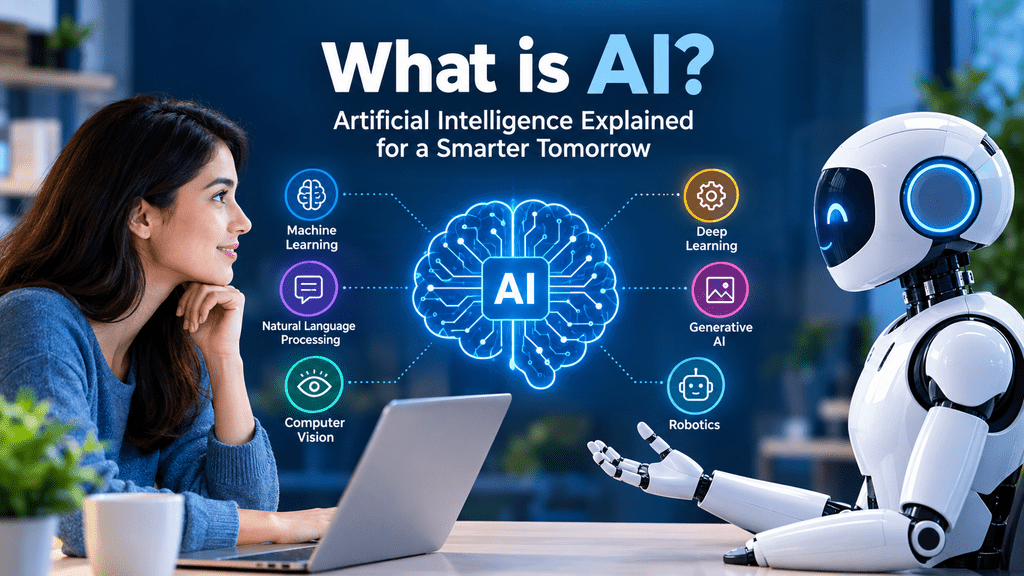
What is AI? Artificial intelligence, commonly called AI, is technology that enables computers and machines to perform tasks that normally require human intelligence, such as understanding language, recognizing patterns, solving problems, making predictions, generating content, and supporting decisions. AI is now part of everyday life, from search engines and recommendation systems to chatbots, smartphones, business software, healthcare technologies, and creative tools. In this guide, we will explain what is AI, how artificial intelligence works, the different types of AI, machine learning, generative AI, real-world applications, benefits, limitations, and what the future may look like.
Artificial intelligence has moved from being a specialist subject in computer science to a technology that affects almost every industry. Understanding its basic concepts can help students, entrepreneurs, employees, creators, and business owners make better decisions about using AI.
What is AI?
So, what is AI in simple words?
Artificial intelligence is a field of technology focused on creating computer systems capable of performing tasks associated with human intelligence. These tasks can include recognizing information, understanding language, identifying patterns, making predictions, recommending actions, and generating new content.
AI does not necessarily mean that a computer thinks exactly like a human. Instead, AI systems are designed to perform particular tasks using algorithms, data, models, computing power, and sometimes feedback from people.
For example, when an email service identifies spam messages, an AI-powered system can analyze patterns in emails and classify suspicious messages. Similarly, a recommendation system can examine a user’s previous activity and suggest products, videos, music, or articles that may be relevant.
According to IBM, artificial intelligence enables computers and machines to simulate capabilities associated with human learning, comprehension, problem-solving, decision-making, creativity, and autonomy.
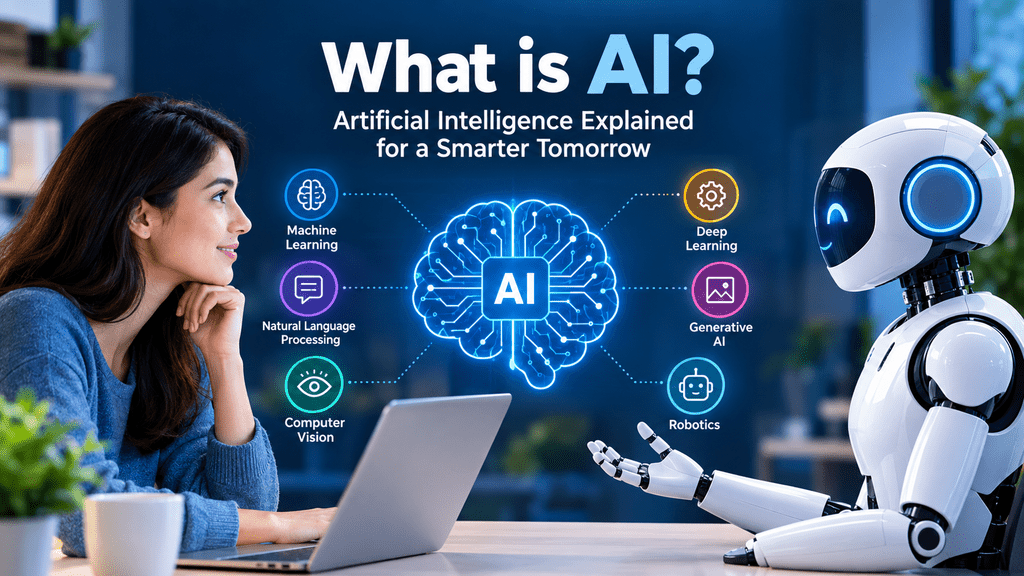
The important point is that AI is a broad field. Machine learning, deep learning, natural language processing, computer vision, and generative AI are connected technologies within the larger AI ecosystem.
How Does Artificial Intelligence Work?
Understanding how AI works becomes easier when we break the process into several basic stages.
1. Data Collection
AI systems usually require data. Depending on the application, this data could include text, images, audio, video, numbers, customer interactions, sensor readings, or other information.
The quality and relevance of data can strongly influence the usefulness of an AI system.
2. Data Processing
Raw data often needs to be cleaned, organized, transformed, or labeled before it can be used effectively.
For example, an image-recognition system may need thousands or millions of images prepared in a suitable format before training.
3. Model Training
In machine learning, algorithms analyze training data to identify patterns. The resulting model can then use those learned patterns to make predictions, classifications, or other outputs.
Google describes machine learning as a way to train software models to make predictions or generate content using data.
4. Testing and Evaluation
After training, an AI model needs to be evaluated. Developers can test how well it performs on information it has not previously encountered.
This helps identify problems such as poor accuracy, bias, overfitting, or unreliable predictions.
5. Deployment
Once a model performs sufficiently well for its intended purpose, it can be integrated into an application, website, business system, device, or other environment.
6. Continuous Improvement
Some AI systems can be updated or retrained as new data becomes available. However, not every AI system automatically learns from every interaction.
This distinction is important because popular descriptions sometimes make AI sound more autonomous than it actually is.
Main Technologies Behind AI
AI includes several important areas of computer science and data technology.
Machine Learning
Machine learning allows systems to learn patterns from data and use those patterns to make predictions or generate outputs.
For example, a machine learning model could analyze previous sales information to estimate future demand.
Deep Learning
Deep learning is a branch of machine learning that uses multi-layered neural networks. It has become particularly important for complex tasks involving images, language, audio, and other large datasets.
Natural Language Processing
Natural language processing, or NLP, focuses on enabling computers to process and work with human language.
NLP is used in chatbots, translation systems, search tools, text classification, voice assistants, and many other applications.
Computer Vision
Computer vision allows computers to analyze and interpret visual information.
Examples include object detection, image classification, facial recognition, medical image analysis, and quality inspection in manufacturing.
Robotics
AI can also be combined with robotics to enable machines to perceive environments, make decisions, and perform physical tasks.
Generative AI
Generative AI can create new content such as text, images, audio, video, software code, and other outputs based on patterns learned from data.
What Is Machine Learning?
Machine learning is one of the most important concepts to understand when learning what is AI.
Traditional software generally follows instructions created by programmers. Machine learning takes a different approach: models can learn patterns from examples and data.
There are several major approaches to machine learning.
Supervised Learning
In supervised learning, a model learns from labeled examples.
For instance, a system could receive many emails labeled as either “spam” or “not spam.” The model learns patterns associated with those categories and can later classify new emails.
Unsupervised Learning
Unsupervised learning works with data without predefined labels. The system can identify patterns, relationships, or groups within the data.
Clustering is one example of an unsupervised learning technique.
Reinforcement Learning
Reinforcement learning involves learning through interaction and feedback. A system receives rewards or penalties based on its actions and attempts to improve its future decisions.
Google provides beginner-friendly resources covering machine learning fundamentals, including supervised and unsupervised learning.
What Is Deep Learning?
Deep learning is a specialized area of machine learning that uses neural networks containing multiple layers.
These networks can process large and complex datasets and are particularly useful for areas such as computer vision, speech recognition, natural language processing, and generative AI.
For example, a deep learning system can be trained to identify objects in photographs. With sufficient training data and appropriate architecture, the model can learn complex visual patterns that help it classify previously unseen images.
Deep learning has played an important role in the rapid development of modern AI applications.
What Is Generative AI?
Generative AI is a type of AI designed to create new content.
Unlike systems that simply classify or predict information, generative models can produce outputs such as:
- Written articles
- Marketing copy
- Computer code
- Images
- Music
- Audio
- Video
- Summaries
- Conversational responses
Large language models are an important example of generative AI. They process language patterns and can generate responses based on user instructions.
Generative AI can be extremely useful, but users should remember that generated information is not automatically correct. AI outputs should be reviewed, fact-checked, and edited when accuracy matters.
Types of Artificial Intelligence
People often describe AI using different classification systems. One common approach is to discuss AI according to its capabilities.
Artificial Narrow Intelligence
Artificial Narrow Intelligence, often called narrow AI, is designed for specific tasks.
Examples include recommendation systems, image recognition systems, spam filters, voice assistants, and many modern generative AI applications.
Narrow AI is the practical form of AI widely used today. IBM notes that narrow AI is currently the only form among the commonly discussed capability categories that actually exists, while broader forms such as artificial general intelligence remain theoretical.
Artificial General Intelligence
Artificial General Intelligence, or AGI, generally refers to a hypothetical form of AI with broad intellectual capabilities across many different types of tasks.
AGI remains a subject of research and debate. It should not be confused with today’s specialized AI systems.
Artificial Superintelligence
Artificial superintelligence is a theoretical concept describing AI that would exceed human intelligence across a very broad range of capabilities.
It is currently speculative rather than an established technology.
Real-World Applications of AI
AI is already being used across many industries.
AI in Healthcare
AI can assist healthcare professionals with medical image analysis, data processing, research, workflow support, and other tasks.
AI can help identify patterns in large datasets, but healthcare decisions require appropriate professional oversight.
AI in Education
Educational platforms can use AI to provide personalized learning experiences, generate practice questions, summarize information, and support teachers and students.
However, students should use AI as a learning aid rather than blindly submitting generated answers.
AI in Marketing
Marketers use AI for:
- Content ideation
- Customer segmentation
- Data analysis
- Personalization
- Predictive analytics
- Advertising optimization
- Customer support
- Keyword research
AI can reduce repetitive work while allowing marketers to spend more time on strategy and creativity.
AI in E-Commerce
Online businesses can use AI to recommend products, analyze customer behavior, improve search, detect suspicious transactions, forecast demand, and personalize shopping experiences.
AI in Finance
Financial organizations use AI for areas such as fraud detection, risk analysis, forecasting, customer service, and document processing.
AI in Software Development
Developers can use AI-assisted tools for code generation, debugging, documentation, testing, and understanding unfamiliar code.
AI does not eliminate the need for developers. Human review remains important because generated code can contain bugs, security issues, or incorrect assumptions.
AI in Customer Service
AI-powered chatbots and virtual assistants can answer common questions, categorize requests, and provide support outside traditional business hours.
Complex or sensitive issues may still require human agents.
Benefits of Artificial Intelligence
There are many potential benefits of AI when it is implemented responsibly.
Increased Productivity
AI can automate repetitive tasks and help people process information more quickly.
Better Data Analysis
AI can identify patterns in large datasets that may be difficult to detect manually.
Personalization
Businesses can use AI to provide more personalized recommendations and experiences.
Faster Decision Support
AI systems can analyze information quickly and provide predictions or recommendations that support human decision-making.
Automation
Routine processes can often be automated, allowing employees to focus on more complex activities.
Accessibility
AI-based speech recognition, translation, text generation, and other technologies can make digital services easier to access for different users.
IBM notes that businesses increasingly use AI for areas such as workflow optimization, customer experience, forecasting, cybersecurity, content creation, and real-time decision support.
Limitations and Challenges of AI
Learning what is AI also means understanding what AI cannot reliably do.
AI Can Make Mistakes
AI systems can produce incorrect answers, inaccurate predictions, or misleading information.
Therefore, users should verify important outputs.
Bias
AI systems can reflect biases present in their training data, development processes, or deployment environments.
Responsible AI development requires testing and monitoring for unfair outcomes.
Privacy Concerns
AI applications may process large amounts of information. Organizations must consider privacy, security, data governance, and applicable laws when collecting and using data.
Lack of Human Judgment
AI can analyze information and generate recommendations, but it does not replace human responsibility in every situation.
Important decisions often require context, experience, empathy, ethical reasoning, and accountability.
Security Risks
AI systems can introduce or amplify cybersecurity and misuse risks. Organizations should apply appropriate security controls when deploying AI.
AI in Business
Artificial intelligence is increasingly becoming a practical business tool rather than simply a research concept.
Businesses can use AI to automate workflows, analyze customer information, improve marketing campaigns, support employees, optimize operations, and generate content.
For example, a small business could use AI to brainstorm marketing ideas, summarize customer feedback, categorize leads, prepare drafts, and analyze business data.
A larger organization might integrate AI into customer support, supply-chain planning, software development, fraud detection, forecasting, or enterprise search.
The best results usually come when organizations identify a specific business problem first and then determine whether AI is actually an appropriate solution.
AI should not be adopted simply because it is popular.
AI vs Machine Learning
One common question after learning what is AI is the difference between AI and machine learning.
The simplest explanation is:
Artificial intelligence is the broader field, while machine learning is one approach used to build AI systems.
Think of AI as a large category.
Inside that category is machine learning.
Inside machine learning are specialized approaches such as deep learning.
Therefore:
AI → Machine Learning → Deep Learning → Neural Network techniques
This is a simplified relationship, but it is useful for beginners. IBM similarly describes AI as the broader concept, with machine learning as a subset and deep learning as a specialized area within machine learning.
How Beginners Can Start Learning AI
If you are new to AI, you do not need to learn everything at once.
Start with the fundamentals.
Step 1: Learn Basic AI Concepts
Understand terms such as AI, machine learning, deep learning, algorithms, datasets, models, neural networks, NLP, computer vision, and generative AI.
Step 2: Experiment With AI Tools
Try practical AI applications for writing, research, image creation, productivity, coding, and data analysis.
The goal is to understand both the capabilities and limitations of these tools.
Step 3: Learn Basic Data Concepts
Understanding datasets, features, labels, training, testing, accuracy, and evaluation will make machine learning easier to understand.
Step 4: Learn Some Programming
Python is widely used in AI and machine learning. Beginners can start with basic programming concepts before moving toward libraries and frameworks.
Step 5: Practice With Real Projects
Instead of only watching tutorials, build small projects.
For example, you could create a simple text classifier, recommendation system, image classifier, or data analysis project.
Google offers a practical Machine Learning Crash Course and additional learning resources for people who want to study machine learning.
The Future of Artificial Intelligence
AI is likely to continue influencing how people work, learn, communicate, create, and make decisions.
Future AI development may include more capable AI assistants, improved multimodal systems, better automation, advanced robotics, personalized software, and increasingly sophisticated AI agents.
AI agents are another emerging area. These systems can be designed to perform tasks on behalf of users by planning workflows, interacting with tools, making decisions, and executing actions.
However, technological progress will also create important questions about privacy, security, employment, copyright, reliability, transparency, and responsible AI development.
The future of AI will therefore depend not only on making systems more capable but also on making them useful, safe, reliable, and appropriately governed.
Frequently Asked Questions About What is AI
What is AI in simple words?
AI is technology that allows computers and machines to perform tasks that normally require aspects of human intelligence, such as recognizing patterns, understanding language, solving problems, making predictions, and generating content.
What is AI used for?
AI is used for many purposes, including search, recommendations, customer support, content generation, fraud detection, healthcare support, marketing, education, software development, forecasting, and automation.
Is ChatGPT an AI?
Yes. ChatGPT is an example of an AI-powered generative system designed to interact with users using natural language.
Is AI the same as machine learning?
No. AI is the broader field. Machine learning is one approach used to develop AI systems.
What is generative AI?
Generative AI refers to AI systems that can create new content, including text, images, audio, video, and code.
Can AI replace humans?
AI can automate some tasks previously performed by people, but it does not mean that every human role will disappear. Many jobs involve communication, judgment, creativity, physical activities, leadership, accountability, and contextual decision-making that may require human involvement.
Is AI always accurate?
No. AI systems can make mistakes and generate incorrect or misleading information. Important information should be independently verified.
Can beginners learn AI?
Yes. Beginners can start by learning basic AI terminology, experimenting with AI tools, studying machine learning fundamentals, learning programming, and completing small practical projects.
Final Thoughts
So, what is AI?
Artificial intelligence is a broad area of technology that enables computer systems to perform tasks associated with human intelligence. It includes machine learning, deep learning, natural language processing, computer vision, generative AI, robotics, and many other technologies.
AI is already changing businesses and everyday digital experiences. From personalized recommendations to AI assistants and automated business processes, its influence continues to grow.
At the same time, AI should not be viewed as a magic solution. Successful AI adoption requires good data, appropriate technology, human oversight, security, responsible development, and a clear understanding of its limitations.
For beginners, the best approach is to start with the fundamentals and gradually move toward practical applications. Once you understand the relationship between AI, machine learning, deep learning, and generative AI, it becomes much easier to understand the rapidly changing AI landscape.
For more technology and AI-related information, visit Riazdadu.com and explore the relevant resources available on the website.
Suggested SEO Images
Featured image: Modern AI concept showing a human interacting with an artificial intelligence interface
Alt text: What is AI - artificial intelligence technology
Image 2: AI, machine learning, and deep learning relationship diagram
Alt text: What is AI and how machine learning works
Image 3: Business professionals using artificial intelligence tools
Alt text: What is AI used for in business
Image 4: Generative AI creating text, images, and code
Alt text: What is AI and generative artificial intelligence
Recommended External Resources
For readers who want to study the subject further, link to authoritative educational resources such as:
- IBM: What is Artificial Intelligence?
- Google Machine Learning Crash Course
- Google Machine Learning Resources
These are strong external references because they provide additional explanations and educational resources about AI and machine learning.
Suggested Internal Linking Strategy
Within the article, add contextual internal links to other relevant pages on Riazdadu.com as those pages become available.
Recommended anchor-text ideas:
- AI tools
- latest AI technology
- AI business ideas
- digital marketing with AI
- generative AI
- machine learning
- technology guides
For example, the sentence:
“AI can help businesses automate repetitive tasks and improve digital marketing workflows.”
can link “digital marketing workflows” to a relevant article on your website.
This creates a stronger internal-link structure without forcing irrelevant links.
Short-Tail Keywords
- AI
- artificial intelligence
- machine learning
- deep learning
- generative AI
- AI tools
- AI technology
- AI applications
- AI software
- AI systems
Long-Tail Keywords
- what is AI
- what is AI in simple words
- what is artificial intelligence
- how does AI work
- how artificial intelligence works
- what is machine learning
- difference between AI and machine learning
- what is generative AI
- types of artificial intelligence
- applications of artificial intelligence
- benefits of artificial intelligence
- limitations of artificial intelligence
- how to learn AI for beginners
- how AI is used in business
- examples of artificial intelligence
- AI technology for beginners
- what can artificial intelligence do
- future of artificial intelligence