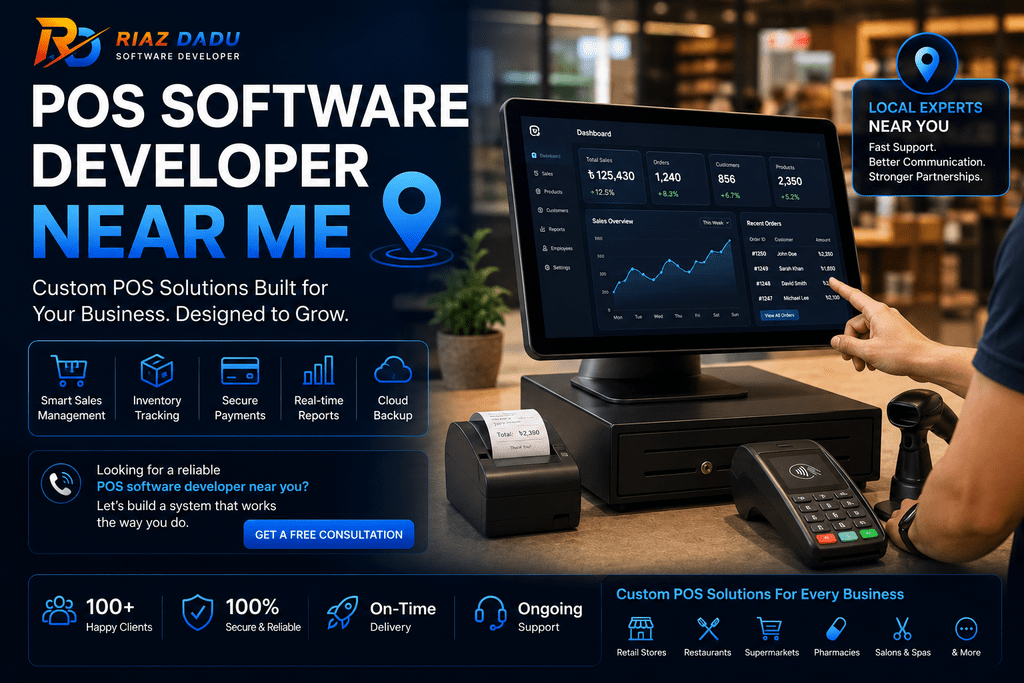
POS Software Developer Near Me — if that’s the phrase that brought you here, you’re likely a business owner who is done fighting with checkout software that doesn’t fit the way you actually run your store, restaurant, or warehouse. Maybe your current system freezes during rush hour. Maybe it can’t talk to your accounting software. Maybe you’re simply outgrowing a one-size-fits-all template. Whatever the reason, you’re looking for a POS software developer near me who can build something that works the way your business works, not the other way around.
At Riazdadu, that’s exactly what we do. This guide walks through everything you need to know before hiring a POS software developer near me — what they actually do, why “near me” matters even in a remote-first world, what features to prioritize, how much it costs, and how our own development process works from first call to launch day.
What Does a POS Software Developer Do?
A POS software developer near me designs, codes, tests, and maintains the systems businesses use to process sales, manage inventory, and track customers at the point of purchase. That sounds simple, but a modern POS system touches far more than the checkout screen.
A skilled developer typically handles:
- The front-end interface cashiers and staff interact with
- The backend database that stores product, pricing, and customer data
- Integrations with card readers, barcode scanners, and receipt printers
- Payment gateway connections that keep transactions secure
- Inventory syncing across one or multiple store locations
- Reporting dashboards for owners and managers
Unlike off-the-shelf POS software, a custom build from a dedicated POS software developer near me is shaped entirely around your workflow. If your restaurant needs split-bill functionality by table, or your retail store needs barcode-based loyalty tracking, that logic gets built specifically for you instead of hidden behind generic settings menus.
Show Image
Why “Near Me” Still Matters When Hiring a POS Developer
Searches like POS software developer near me have grown steadily as more small and mid-sized businesses move away from manual registers and generic templates. Research published by Statista shows point-of-sale software adoption continuing to expand globally as businesses look for more flexible, data-driven checkout systems.
But why does “near me” matter if most development today happens over video calls and shared screens? A few real reasons:
Faster response during outages. When your checkout system goes down at 6 PM on a Saturday, you want a developer who understands urgency and responds quickly — not a support ticket that gets answered in three days.
Local payment and tax knowledge. Tax rules, currency formats, and popular local payment methods vary by region. A developer familiar with your market builds those details in from day one instead of retrofitting them later.
Accountability. A nearby, reachable team — even one working primarily online, like Riazdadu — tends to feel more accountable for long-term support than an anonymous overseas contractor you’ll never speak with again after launch.
Better communication. Time zone overlap alone makes a massive difference in how quickly bugs get fixed and features get shipped.
Signs You’ve Outgrown Your Current POS System
Not every business needs custom software immediately. But there are clear warning signs that it’s time to search for a POS software developer near me rather than patch together another workaround.
You’re Manually Reconciling Data
If your team spends evenings manually matching sales totals against inventory counts, your software isn’t doing its job.
Multiple Locations Aren’t Talking to Each Other
Generic POS tools often struggle once you open a second location. Inventory, pricing, and reporting should sync automatically — not require spreadsheets stitched together by hand.
No Offline Mode
Internet outages happen. If your current system can’t process a sale without a live connection, you’re losing revenue every time the connection drops.
Rigid, Unchangeable Workflows
If your staff has to “work around” the software instead of the software supporting their actual process, that’s a sign the system was never built for your business.
Poor Integration with Other Tools
Your POS should talk to your accounting software, CRM, and e-commerce platform. If it doesn’t, you’re duplicating work constantly.
If two or more of these sound familiar, it’s a strong signal that custom development, not another off-the-shelf subscription, is the right next step.
Core Features a Good POS System Needs
Before hiring a POS software developer near me, it helps to know what a strong system should actually include:
- Secure payment processing compliant with card network standards
- Real-time inventory tracking across every sales channel
- Offline mode with automatic syncing once connectivity returns
- Role-based staff access so employees only see what they need
- Detailed reporting on sales trends, best-sellers, and slow periods
- Customer relationship tools like loyalty points or purchase history
- Hardware flexibility to work with your existing scanners and printers
A short two-minute walkthrough video demoing these features in action can also help non-technical stakeholders understand exactly what they’re paying for — something we typically provide during the proposal stage at Riazdadu.
What to Look For in a POS Software Developer
Choosing the right POS software developer near me goes well beyond comparing hourly rates. Here’s what actually matters.
1. Relevant Industry Experience
Ask for real examples of systems built for businesses like yours. A POS system for a busy restaurant looks nothing like one built for a multi-location pharmacy chain.
2. Security and Compliance Knowledge
Since payment data is involved, your developer should understand PCI-DSS standards, outlined by the PCI Security Standards Council, and build with security as a foundation, not an afterthought.
3. Transparent, Ongoing Communication
A trustworthy developer explains decisions in plain language, gives realistic timelines, and doesn’t disappear once the invoice is paid.
4. Post-Launch Support Plans
Software isn’t finished at launch — it needs monitoring, bug fixes, and updates as your business grows. Ask specifically how support works after go-live.
5. Scalability Planning
Even if you only have one location today, ask how the system would handle a second, third, or tenth. Building for scale from the start avoids expensive rebuilds later.
Industries That Benefit Most from Custom POS Software
While almost any transaction-based business can benefit from working with a POS software developer near me, some industries see especially large returns:
Retail Stores — custom barcode systems, loyalty tracking, and multi-location inventory syncing.
Restaurants and Cafes — table management, split billing, kitchen display integration, and delivery platform syncing.
Salons and Spas — appointment-linked checkout, staff commission tracking, and package/membership billing.
Pharmacies — prescription tracking tied directly to inventory and compliance reporting.
Warehouses and Wholesalers — bulk order processing, B2B pricing tiers, and purchase order automation.
Each of these use cases requires workflow logic that generic POS software simply wasn’t built to handle out of the box.
Common Mistakes Businesses Make When Hiring a Developer
Even well-intentioned business owners make avoidable mistakes when searching for a POS software developer near me. Watch out for these:
- Choosing based on price alone. The cheapest quote often means cut corners on security or support.
- Skipping the discovery phase. A developer who doesn’t ask detailed questions about your workflow before quoting a price is guessing, not planning.
- Ignoring post-launch support terms. Get support agreements in writing before the project starts, not after something breaks.
- Not asking about data ownership. Confirm upfront that you own your sales and customer data outright.
- Underestimating training time. Even the best system needs a short onboarding period for staff — plan for it.
How Riazdadu Builds Custom POS Systems
As a POS software developer near me, our process at Riazdadu is built around clarity and communication at every stage.
Step 1: Discovery
We start with a detailed conversation about your workflow, hardware, staff structure, and pain points with your current system.
Step 2: Design
Next, we map out the interface and database structure, often sharing wireframes and short walkthrough videos so you can review the plan before any code is written.
Step 3: Development
Our team builds the core system, wiring in secure payment processing, inventory logic, and any custom features specific to your business.
Step 4: Testing
We stress-test the system under real transaction volumes to catch issues before they ever reach your checkout counter.
Step 5: Launch and Support
We go live together, with staff training included, and ongoing support to handle updates, bug fixes, and future feature requests.
We also offer web and app development services alongside POS builds, so your point-of-sale system can connect seamlessly with your online store, booking platform, or customer-facing app. You can browse examples of past projects on our portfolio page, and when you’re ready to talk specifics, reach out through our contact page.
Custom POS Software vs. Off-the-Shelf Providers
One of the biggest decisions before hiring a POS software developer near me is whether to go custom at all. Off-the-shelf platforms are fast to set up and often cheaper upfront, but they come with real trade-offs.
| Factor | Off-the-Shelf POS | Custom POS (Hired Developer) |
|---|---|---|
| Setup speed | Fast, plug-and-play | Slower, but built to spec |
| Workflow fit | Generic, one-size-fits-all | Matches your exact process |
| Monthly fees | Ongoing subscription, often per terminal | One-time build, optional support plan |
| Integrations | Limited to what the provider supports | Built to connect with any tool you use |
| Scalability | Often capped by plan tier | Designed to grow with your business |
| Ownership | You rent access to the software | You typically own the code and data |
Neither option is universally “better” — a single-location coffee shop with simple needs may do just fine on an off-the-shelf plan. But once your workflow becomes more specific, or you’re paying monthly for features you barely use, working with a POS software developer near me usually pays for itself within the first year or two.
What a Typical Project Timeline Looks Like
Business owners searching for a POS software developer near me often want a realistic sense of how long a project actually takes before committing. While every build is different, a typical mid-sized project follows a pattern like this:
- Week 1–2: Discovery calls, workflow mapping, and requirements gathering
- Week 3–4: Interface design and database architecture, shared for feedback
- Week 5–8: Core development, including payment integration and inventory logic
- Week 9: Internal testing and stress-testing under simulated transaction loads
- Week 10: Staff training, data migration, and final walkthroughs
- Week 11: Launch, with a support team on standby for the first few days
Larger, multi-location builds with custom integrations can extend this timeline to several months, while simpler single-terminal systems can sometimes launch in as little as three to four weeks.
A Real-World Example of Custom POS in Action
To make this more concrete, imagine a small retail chain running three locations on three completely disconnected systems. Staff at each store manually emailed daily sales totals to a head office spreadsheet every evening, and stock counts were frequently wrong because nothing synced automatically.
After working with a POS software developer near me, the business moved to one unified system: every terminal reported sales and inventory in real time, managers could see stock levels across all three locations from a single dashboard, and the nightly manual reporting process disappeared entirely. Staff also stopped guessing which items were low in stock at other branches, since transfers could now be requested directly through the system.
This kind of transformation is common. It’s rarely about flashy new technology — it’s about removing the manual, error-prone steps that generic software forces business owners to work around every single day.
How Much Does a Custom POS System Cost?
Costs vary significantly depending on scope. A single-location system with standard checkout and inventory features costs far less than a multi-location build with custom integrations, loyalty programs, and advanced reporting.
Generally, pricing depends on:
- Number of locations and terminals
- Complexity of inventory and reporting needs
- Third-party integrations (accounting, CRM, e-commerce)
- Offline functionality requirements
- Ongoing support and maintenance scope
The best way to get an accurate estimate is a discovery call, where a POS software developer near me can scope your specific requirements rather than guessing from a generic price list.
Questions to Ask Before You Hire
Before signing off on any proposal, it’s worth bringing a short list of questions to your first conversation with a POS software developer near me. This helps you compare quotes fairly and avoid surprises later.
Ask about their testing process. A developer should be able to explain how they simulate real transaction volumes before launch, not just assure you it “should work fine.”
Ask how updates are handled after launch. Some developers include a fixed period of free support, while others charge hourly for every change. Get this in writing.
Ask about data backups and recovery. Your sales and customer data is one of your most valuable business assets. Confirm how often backups run and how quickly data can be restored if something goes wrong.
Ask for a rough project timeline in writing. Verbal estimates tend to slip. A written timeline, even with some flexibility built in, keeps both sides accountable.
Ask what happens if you want to switch developers later. A trustworthy POS software developer near me should hand over full documentation and access, not lock your system behind proprietary tools only they can touch.
Bringing a short checklist like this to your first call signals that you’re a serious client, and it usually results in a more honest, detailed proposal in return.
Frequently Asked Questions
How much does it cost to hire a POS software developer near me? Costs vary based on features, integrations, and the number of locations involved. Simple single-location systems cost far less than multi-store, multi-currency builds.
Can a POS software developer near me work remotely? Yes. Most modern development, including ours at Riazdadu, happens remotely through video calls, screen shares, and remote deployment, while still offering the responsiveness of a local team.
How long does it take to build custom POS software? Simple systems can launch in a few weeks. Larger, multi-location builds with custom integrations may take a few months from discovery to launch.
Will my staff need training on a custom POS system? Yes, though most custom systems are designed around your existing workflow, which typically makes training faster than switching to a generic third-party platform.
What happens if something breaks after launch? A reliable developer includes a support plan covering bug fixes and updates. Always confirm these terms before the project begins.
Can custom POS software integrate with my online store? Yes. A skilled developer can sync inventory and sales data between your physical checkout and your e-commerce platform in real time.
Do I own the software once it’s built? This depends on your contract, so confirm data and code ownership terms upfront with any developer you hire.
What’s the difference between a POS developer and a POS reseller? A reseller sells and configures existing third-party software, while a POS software developer near me builds or heavily customizes the system itself. Resellers are faster and cheaper for standard needs; developers are the better fit when your workflow doesn’t match a generic template.
Can a custom POS system handle multiple currencies or languages? Yes. Multi-currency and multi-language support can be built directly into the system, which is especially useful for businesses serving diverse customer bases or operating across borders.
Is custom POS software more secure than off-the-shelf options? Not automatically — security depends on how the system is built, not whether it’s custom or off-the-shelf. A qualified POS software developer near me should follow recognized standards like PCI-DSS regardless of the build type.
What hardware works with a custom POS system? Most custom systems are built to work with standard barcode scanners, receipt printers, and card readers already on the market, so you typically don’t need to replace existing hardware.
How do I get started with Riazdadu? Simply visit our contact page to schedule a discovery call. We’ll walk through your current setup, pain points, and goals before proposing a scope and timeline.