Choosing between WooCommerce vs Shopify for a Dubai online store is one of the biggest decisions you will make before your first sale. The platform you pick affects your launch speed, your monthly costs, how your customers pay, and how easily Google can find your products.
Dubai is not a typical e-commerce market. Shoppers expect Arabic and English content, cash on delivery, Apple Pay, and buy-now-pay-later options like Tabby and Tamara. Businesses must also handle 5% VAT, local couriers, and trade-license-based payment gateway approval. A guide written for the US or UK will miss most of this.WooCommerce vs Shopify for Dubai online store.
This guide compares both platforms through a Dubai lens. You will see real cost factors, payment options, SEO strength, Arabic support, and clear advice on who should choose which. If you want a fast answer, here it is:
- Choose Shopify if you want a fast, low-maintenance launch and your team is not technical. WooCommerce vs Shopify for Dubai online store.
- Choose WooCommerce if you want full control, strong content SEO, deep customization, and lower long-term fees. WooCommerce vs Shopify for Dubai online store.
Read on to see which one fits your business.
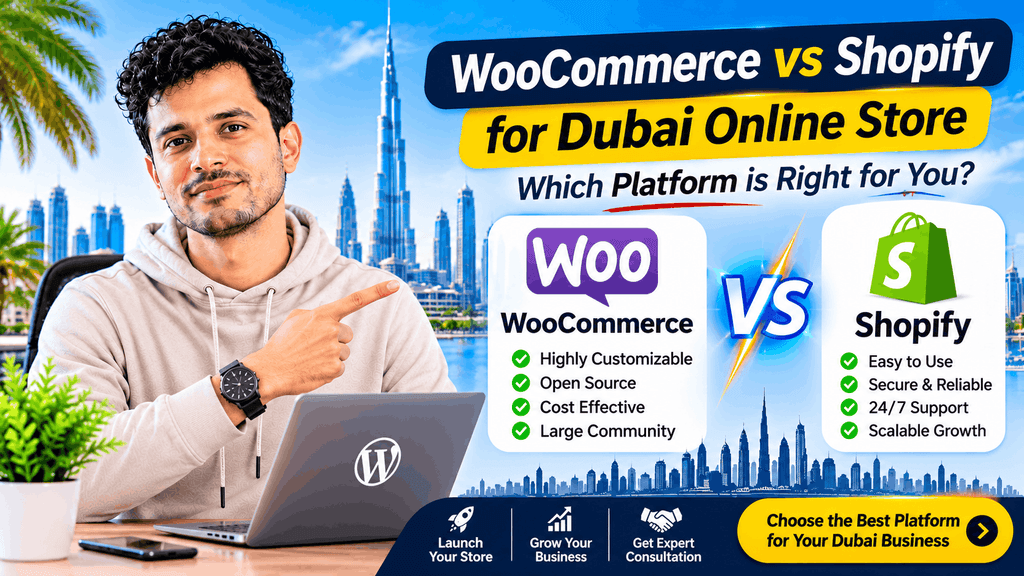
Quick Comparison: WooCommerce vs Shopify in Dubai
| Factor | WooCommerce | Shopify |
|---|---|---|
| Type | Free WordPress plugin, self-hosted | Hosted subscription platform |
| Setup speed | Moderate (days to weeks) | Fast (hours to days) |
| UAE payment gateways | Almost all, via plugins | Many, via apps and integrations |
| Transaction fees | None from the platform | Extra fee on third-party gateways, depending on plan |
| Arabic and RTL | Excellent, full control | Good, theme dependent |
| Content SEO | Excellent (WordPress) | Good, more limited blogging |
| Maintenance | You manage hosting and updates | Shopify manages it |
| Best for | Content-rich, custom, growing stores | Fast launches, small teams, dropshipping |
What Is WooCommerce?
WooCommerce is a free, open-source e-commerce plugin for WordPress. You install it on your own hosting, and it turns a WordPress website into a full online store. You own your data, your design, and your code. WooCommerce vs Shopify for Dubai online store.
For a WooCommerce Dubai store, that freedom matters. You can connect nearly any UAE payment gateway, build bilingual product pages, add custom delivery rules for emirates, and tune every SEO detail. WooCommerce vs Shopify for Dubai online store.
Pros of WooCommerce for Dubai
- No platform subscription fee. The core plugin is free. You pay for hosting, a theme, and extensions. WooCommerce vs Shopify for Dubai online store.
- No platform transaction fees. You only pay your payment gateway’s own charges. WooCommerce vs Shopify for Dubai online store.
- Full SEO control. You can edit URLs, schema, sitemaps, and page speed at a deep level.
- Strong Arabic and multilingual support. WordPress handles RTL layouts and plugins like WPML or Polylang well. WooCommerce vs Shopify for Dubai online store.
- Flexible checkout. You can add cash on delivery, local couriers, and custom VAT display. WooCommerce vs Shopify for Dubai online store.
Cons of WooCommerce for Dubai
- You manage the technical side. Hosting, security, backups, and updates are your responsibility.WooCommerce vs Shopify for Dubai online store.
- Costs can scatter. Extensions, premium themes, and developer time add up.
- Speed depends on setup. A poor host or heavy plugins can slow your store.
What Is Shopify?
Shopify is a hosted e-commerce platform. You pay a monthly plan, and Shopify handles hosting, security, and updates. Your store is live quickly, and the admin panel is easy to learn.WooCommerce vs Shopify for Dubai online store.
For a Shopify UAE store, the main question is payments. Availability of Shopify Payments in the UAE has changed over time, and sources disagree on which plans are covered. Some recent merchant reports say it has opened to the Advanced plan in addition to Plus, while older guides say it is unavailable. Always confirm in your own Shopify admin before you plan around it. Most Dubai merchants still use third-party gateways.WooCommerce vs Shopify for Dubai online store.
Pros of Shopify for Dubai
- Fast launch. You can have a working store in days.
- Reliable hosting and security. Shopify handles uptime, SSL, and PCI compliance.
- Polished themes and apps. The app store covers reviews, upsells, loyalty, and shipping.
- Easy for non-technical owners. Less to break, less to maintain.
- Strong for social selling. Instagram, TikTok, and Facebook integrations are smooth.
Cons of Shopify for Dubai
- Extra transaction fees. If you do not use Shopify Payments, Shopify typically charges an additional fee on each order. It is lower on higher plans, roughly between 0.6% and 2%.WooCommerce vs Shopify for Dubai online store.
- App costs add up. Many useful features need paid apps.
- Limited blogging and URL control. Shopify’s content tools are weaker than WordPress.WooCommerce vs Shopify for Dubai online store.
- Less customization. Deep changes need Liquid coding or workarounds.
Cost Comparison: What Will You Really Pay in Dubai?
Price is where most owners start, but the sticker price is rarely the full story. Here is what to budget for each platform.
WooCommerce Cost Breakdown
- Hosting: Quality managed WordPress hosting, ideally with a nearby data centre or a global CDN.
- Domain and SSL: Low annual cost, and SSL is often free.
- Theme: Free or premium, often a one-time or yearly purchase.
- Extensions: Subscriptions, bookings, bilingual tools, and shipping plugins.
- Development: A one-time build, plus occasional maintenance.
- Payment gateway fees: Typically a percentage per transaction.
Shopify Cost Breakdown
- Monthly plan: Plans start at roughly $29 to $39 per month and rise to several hundred for advanced plans, depending on billing cycle.WooCommerce vs Shopify for Dubai online store.
- Theme: Free or paid.
- Apps: Monthly subscriptions that can stack quickly.
- Third-party gateway fee: Added on top of your gateway’s own charges when you do not use Shopify Payments.
- Development: Lower for simple stores, higher for custom work.
Which Is Cheaper?
For a small store with a simple catalog, Shopify is often easier to budget in year one. For a growing store with many orders, WooCommerce usually becomes cheaper over three years, because you avoid the extra platform fee on every sale. Run the numbers using your expected monthly order volume before you decide.WooCommerce vs Shopify for Dubai online store.
UAE Payment Gateways: WooCommerce vs Shopify
Payments are the make-or-break factor for any Dubai online store. Customers want cards, Apple Pay, cash on delivery, and installment options.WooCommerce vs Shopify for Dubai online store.
Common UAE Payment Options
- Telr
- PayTabs
- Amazon Payment Services (formerly PayFort)
- Network International
- Stripe (available in the UAE)
- Checkout.com
- Tabby and Tamara (buy now, pay later)
- Cash on delivery
Most gateways need a valid UAE trade license and a corporate bank account. Approval often takes about one to two weeks, so start early.WooCommerce vs Shopify for Dubai online store.
WooCommerce Payments in the UAE
WooCommerce supports almost every major UAE and Middle East gateway through plugins. Cash on delivery is built in. You can also add BNPL options and customize which methods appear for which customers.WooCommerce vs Shopify for Dubai online store.
Shopify Payments in the UAE
Shopify supports many of the same gateways through apps and integrations, including Telr, PayTabs, and Stripe. Cash on delivery and BNPL are available, though setup quality varies by provider. Without Shopify Payments, some features such as local-currency pricing for other GCC countries may be restricted, so check the details for your plan.WooCommerce vs Shopify for Dubai online store.
Verdict: WooCommerce is more flexible. Shopify is simpler. Both can support a strong Dubai checkout.WooCommerce vs Shopify for Dubai online store.
Arabic, RTL, and Bilingual Store Support
Dubai shoppers use both English and Arabic, and an Arabic version often improves trust and conversions. Your platform must support right-to-left layouts, translated URLs, and clean hreflang tags.WooCommerce vs Shopify for Dubai online store.
WooCommerce
WordPress supports Arabic out of the box. With WPML, Polylang, or TranslatePress, you can translate products, categories, and checkout. You control URLs and hreflang. RTL themes are widely available.
Shopify
Shopify supports multiple languages through its Markets and translation features, and many themes include RTL. It works well, but you depend more on theme quality and app choices for full Arabic SEO control.
Verdict: WooCommerce gives deeper control. Shopify is easier if you pick a quality RTL theme.
SEO Comparison: Which Ranks Better on Google?
Both platforms can rank well. Neither is magic. What matters is page speed, clean structure, strong content, and technical SEO. Google’s own SEO Starter Guide explains the fundamentals that apply to every platform.
WooCommerce SEO Strengths
- Full URL control for products, categories, and blog posts.
- Powerful blogging with WordPress, ideal for topical authority.
- Advanced SEO plugins such as Yoast SEO or Rank Math.
- Flexible schema markup for products, reviews, FAQs, and breadcrumbs.
- Server-level optimization for speed and caching.
Shopify SEO Strengths
- Solid technical base with automatic sitemaps and canonical tags.
- Fast, reliable hosting by default.
- Built-in SSL and mobile-friendly themes.
- Easy meta title and description editing.
Shopify SEO Limits
- Fixed URL structure such as /products/ and /collections/
- Less flexible blogging
- Duplicate-content risks from collection-based product URLs, which need careful canonical handling
Core Web Vitals
Google uses page experience signals, including Core Web Vitals, to evaluate speed and usability. Shopify is fast out of the box. WooCommerce can be just as fast, but only with good hosting, caching, image compression, and a lightweight theme.
Verdict: WooCommerce has the higher SEO ceiling, especially for content-driven strategies. Shopify has a safer floor for beginners.
Customization and Scalability
WooCommerce
Because the code is open, you can build almost anything: custom product pages, wholesale pricing, subscriptions, marketplace features, and complex delivery logic across the emirates. It scales well, provided your hosting and development are solid.
Shopify
Shopify scales smoothly in traffic, since Shopify manages the infrastructure. Customization is easier with apps, but deep changes can be limited or costly. Shopify Plus offers more control for large brands.
Verdict: WooCommerce for custom builds. Shopify for predictable, hands-off scaling.
Security and Maintenance
Shopify handles security, hosting, backups, and PCI compliance. That is a major relief for small teams.
With WooCommerce, you are responsible. That means:
- Keeping WordPress, themes, and plugins updated
- Running regular backups
- Using a firewall and malware scanning
- Choosing reputable hosting
A good maintenance plan makes WooCommerce safe, but it is a real ongoing task. If you do not have a developer or agency, Shopify removes this burden.
VAT, Shipping, and Local Logistics in the UAE
The UAE charges 5% VAT, and registered businesses must show it correctly on invoices. The Federal Tax Authority at tax.gov.ae provides official guidance. Both platforms can display prices with VAT and generate compliant invoices, usually with a plugin or app.
For delivery, both platforms integrate with major UAE couriers and aggregators. WooCommerce gives you more control over emirate-based rates, same-day delivery rules, and cash-on-delivery fees. Shopify handles standard rules easily, but complex local logic may require an app.
Which Should You Choose? Decision Guide
Choose Shopify If
- You want to launch quickly
- You are a solo founder or small team
- You sell a small to medium catalog
- You do dropshipping or social-first selling
- You prefer predictable maintenance
Choose WooCommerce If
- Content marketing and SEO are core to your growth
- You need a strong Arabic and English store
- You want custom checkout, pricing, or delivery rules
- You expect high order volume and want to avoid extra platform fees
- You already use WordPress
Real-World Scenarios
- A Dubai fashion boutique launching on Instagram: Shopify is a smart fit for speed and social tools.
- A perfume brand with a large blog and Arabic audience: WooCommerce wins on SEO control and bilingual content.
- A B2B supplier with custom pricing: WooCommerce handles tiered logic more naturally.
- A first-time seller testing one product: Shopify reduces setup risk.
Step-by-Step: How to Decide in One Afternoon
- List your must-have features, such as Arabic, BNPL, cash on delivery, and B2B pricing.
- Estimate monthly orders for the next 12 and 36 months.
- Check gateway availability with your preferred UAE provider.
- Calculate three-year cost for both platforms, including apps, hosting, and fees.
- Assess your technical support: do you have a developer or agency?
- Decide your SEO strategy: heavy content favors WooCommerce.
- Run a small prototype on both, if time allows, and compare the experience.
Common Mistakes Dubai Store Owners Make
- Choosing only on monthly price and ignoring transaction and app fees
- Skipping Arabic until after launch
- Applying for a payment gateway too late
- Using cheap hosting for WooCommerce
- Ignoring VAT display and invoice rules
- Launching without product schema and a sitemap
Final Verdict: WooCommerce vs Shopify for a Dubai Online Store
There is no single winner. For a Dubai online store, Shopify is best for speed, simplicity, and low maintenance. WooCommerce is best for flexibility, SEO depth, bilingual control, and long-term cost efficiency.
If you plan to grow through content, Arabic and English search, and custom customer journeys, WooCommerce is usually the stronger long-term foundation. If you want to start selling this month with minimal technical work, Shopify is a confident choice.
Need help deciding or building? Explore the e-commerce SEO services and contact MD Riaz Uddin for a free review of your store plan.
Frequently Asked Questions (FAQ)
1. Is WooCommerce or Shopify better for a Dubai online store?
Shopify is better for fast, low-maintenance launches. WooCommerce is better for customization, SEO control, and Arabic and English content. The best choice depends on your budget, team, and growth plan.
2. Is WooCommerce cheaper than Shopify in the UAE?
Often yes over the long term, because WooCommerce has no platform transaction fee. Shopify can be simpler to budget at the start. Compare three-year costs using your expected order volume.
3. Does Shopify work with UAE payment gateways?
Yes. Shopify works with gateways such as Telr, PayTabs, Stripe, and Network International. Shopify Payments availability in the UAE has changed, so confirm your plan’s eligibility in your admin.
4. Does WooCommerce support UAE payment gateways?
Yes. WooCommerce supports almost all UAE and Middle East gateways, plus cash on delivery and BNPL providers like Tabby and Tamara.
5. Which platform is better for Arabic SEO?
WooCommerce offers deeper control over Arabic URLs, hreflang, and content. Shopify supports Arabic well, but depends more on your theme and apps.
6. Can I sell cash on delivery on both platforms?
Yes. Both support cash on delivery, which remains popular in the UAE. WooCommerce has it built in, and Shopify offers it as a manual payment method.
7. Do I need a trade license to open a Dubai online store?
In most cases, yes. Most payment gateways require a valid UAE trade license and a corporate bank account to approve your merchant account.
8. How do I handle 5% VAT on my store?
Register with the Federal Tax Authority if you meet the threshold, then configure tax settings and compliant invoices on your platform. Check official guidance on tax.gov.ae.
9. Which platform is faster?
Shopify is fast by default. WooCommerce can match it with quality hosting, caching, optimized images, and a lightweight theme.
10. Can I migrate from Shopify to WooCommerce later?
Yes. Products, customers, and orders can be migrated with tools or a developer. Plan 301 redirects to protect your SEO rankings during the move.